


NEWS
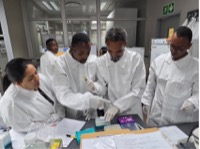
At KRISP, two emerging scientists show how resilience, faith, and purpose are driving a new generation of genomics research.

Groundbreaking clinical study, VIBRANT, signals a new direction for Bacterial Vaginosis (BV) treatment.


SU has joined a leading global network shaping how emerging technologies are understood, governed and applied. Through its Policy Innovation Lab, SU is strengthening international collaboration on AI and digital policy while positioning South Africa within key global conversations.
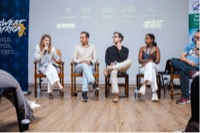
A conversation at SWEAT Africa 2026 explored both the promise of AI and the profound uncertainties that come with increasingly autonomous systems.
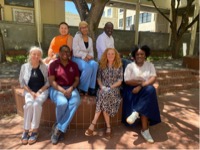
The launch of the Social Science Unit (SSU) at CERI marks a strategic shift toward integrating social science into epidemic response and health research in Africa.
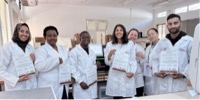
Yes! We Can End TB. Led by South Africa. Powered by Innovation.

Neonatal sepsis remains a leading cause of newborn mortality in sub-Saharan Africa, yet the systems designed to manage it are increasingly out of step with reality.
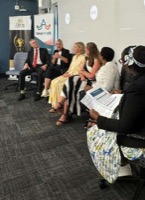
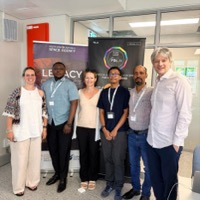
Haingo Andry, PhD candidate at CERI, Stellenbisch University attended the FDL Foundations Africa Workshop, and shares his highlights and key takeouts.

A €1.36 million Horizon Europe grant is enabling the South African Centre for Epidemiological Modelling and Analysis (SACEMA) to expand a long-running initiative that is reshaping how epidemic modelling is taught, applied, and sustained.
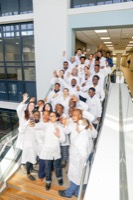
Access is often the difference between potential and progress. For two African STARS fellows, it led directly to employment, independence, and the ability to shape what comes next.
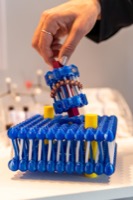
Nanosene, a startup that attended SWEAT Africa 2026, is focused on translating academic research into practical tools for drug discovery and life-science research.

Prof Houriiyah Tegally’s Wellcome-funded research programme brings genomics, data science, and environmental insight together to better understand how infectious diseases emerge and spread across Africa.
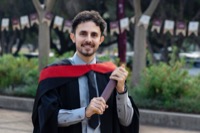
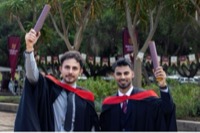
There is a particular kind of courage it takes to leave everything familiar and build something new on the other side of the world. On 24 March, at the Stellenbosch University Faculty of Science graduation ceremony, Danilo De Silva walked across the stage to receive his MSc in Computer Science. For Danilo, that journey started not with ambition, but with an invitation.
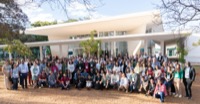
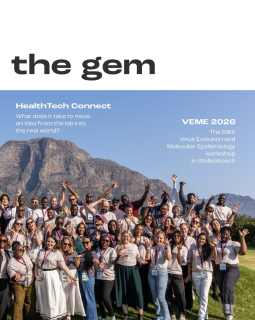
The 29th International Workshop on Virus Evolution and Molecular Epidemiology (VEME) will take place in Stellenbosch, South Africa, from 6–11 September 2026. Over six intensive days of lectures, practical sessions, and keynote presentations, leading researchers from around the world will provide in-depth training in bioinformatics applied to virus evolution and molecular epidemiology. Participants gain both the theoretical knowledge and practical skills needed to tackle complex genomic questions, contribute to research, and support public health initiatives.
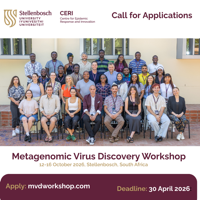
CERI at Stellenbosch University invite applications for a five-day intensive Training in Metagenomic Virus Discovery. This hands-on workshop will be led by global experts, offering participants practical skills and strategies in virus discovery—from project design to advanced analysis.
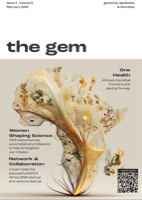
This edition of the gem centres on a simple idea: health is interconnected. At CERI, One Health guides how we link genomics, ecology, surveillance, and delivery to build solutions that work in real-world African contexts. We celebrate four CERI and SU PhD fellows awarded the Oppenheimer Memorial Trust Fellowship, a KRISP Fellow that got awarded a fellowship to go to Switzerland and welcome Professors Carla Mavian and Jo-Ann Passmore at CERI, whose expertise will strengthen our efforts to bettering public health. Across research and partnerships, one message is clear: with the right alignment, Africa can lead the future of integrated health innovation.

Prof Jo-Ann Passmore, one of South Africa's leading voices in women's health immunology, joins CERI at Stellenbosch University.

Over 440 participants from 15 African countries and 22 countries globally gathered in Stellenbosch on 13–14 February for SWEAT Africa 2026. These included 150+ founders, 100+ students, 50+ investors, 50+ researchers, and 90+ ecosystem builders who came together not simply to present ideas, but to engage across sectors that do not always meet in the same room
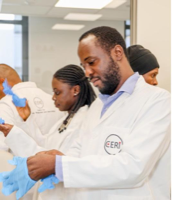
African STARS Fellow, Dr Alex Nka. Across Africa, epidemics do not unfold in laboratories. They unfold within complex systems shaped by funding structures, climate shifts, diagnostic capacity, and policy responsiveness.
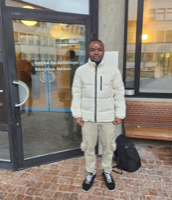
Dr Hastings Musopole begins his research exchange in Switzerland.
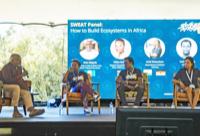
On 14 February 2026, Day 2 of SWEAT Africa’s debut festival, an inspiring panel turned the spotlight on a question central to innovation: what does it actually take to build ventures that endure? True to SWEAT’s outdoor, movement-driven format – where dialogue continues between walks, runs and yoga –the discussion carried that same forward energy into a focused, practical exploration of systems, funding alignment and real-world impact.
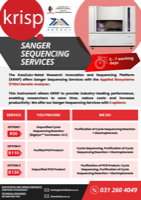
KRISP Sanger Sequencing Services promotion for 2026. Access the largest ABI 3730xl sequencer in Africa at very affordable rates.
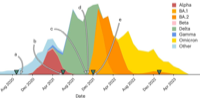
The majority of SARS-CoV-2 genomes obtained during the pandemic were derived by amplifying overlapping windows of the genome (‘tiled amplicons’), reconstructing their sequences and fitting them together. This leads to systematic errors in genomes unless the software is both aware of the amplicon scheme and of the error modes of amplicon sequencing.
Hosted by the Public Squares Initiative at Stellenbosch University, this podcast bridges the gap between research and society through conversation and dialogue with researchers, practitioners, and community members. At the heart of these conversations is transdisciplinary research — research that is collaborative, engaged and impactful.
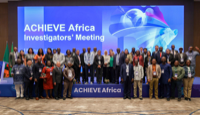
CERI attended the launch of ACHIEVE Africa – a five-year, African led initiative designed to accelerate the development of safe and effective vaccines and biologics across the continent.
MOST POPULAR
BLOG

KRISP has been created by the coordinated effort of the University of KwaZulu-Natal (UKZN), the Technology Innovation Agency (TIA) and the South African Medical Research Countil (SAMRC).


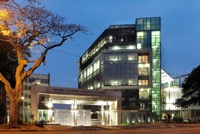
Location: K-RITH Tower Building
Nelson R Mandela School of Medicine, UKZN
719 Umbilo Road, Durban, South Africa.
Director: Prof. Tulio de Oliveira