
World Tuberculosis (TB) Day 2026
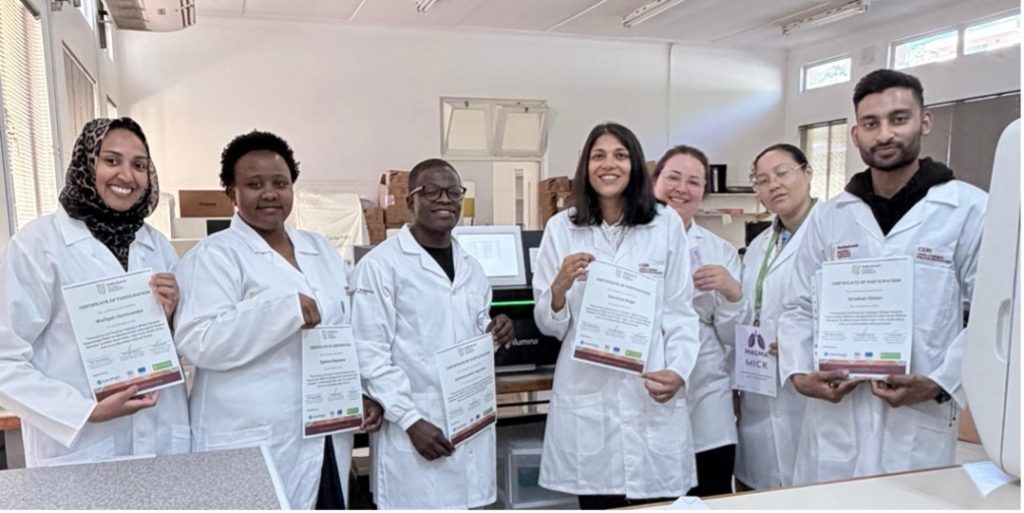
On any given day inside the National Health Laboratory Service (NHLS) laboratory in Green Point, Cape Town, laboratory staff work with samples that represent real people, real infections, and real opportunities to interrupt tuberculosis (TB) transmission with accurate diagnostics. Increasingly, these efforts are being strengthened by genomic technologies that help researchers understand how TB spreads and how drug resistance emerges.
This work reflects the spirit of World TB Day, observed each year on 24 March, which renews the global commitment to ending TB. The World TB Day 2026 campaign highlights the importance of leadership, innovation, and collaboration in addressing one of the worldâs deadliest infectious diseases.
Strengthening National Laboratory Capacity
In November 2025, laboratory scientists and researchers gathered at NHLS Green Point for a two week-programme on âTheoretical and Practical Training in Whole-Genome Sequencing (WGS) for Mycobacterium tuberculosis Clinical Samplesâ. The initiative was delivered as part of GenPath Africa, integrating work on genomic surveillance, the Precision Action for Rifampicin-Resistant Tuberculosis (PARR-TB) sub-study, and capacity development across the network.
The aim of the programme was to strengthen national capacity for TB genomic surveillance by equipping NHLS scientists with the theoretical knowledge and practical skills required to generate and interpret WGS data. These technologies are transforming TB research and public health by enabling faster detection of drug resistance and improved understanding of transmission dynamics. It also highlights the role of academic institutions in strengthening public health systems.
The programme brought together NHLS scientists, technologists, pathologists, and early-career researchers, highlighting the multidisciplinary expertise required to implement genomic surveillance within routine laboratory practice.
By hosting the training within the NHLS laboratory environment, the initiative helps embed these skills directly within the national diagnostic infrastructure, strengthening the ability of laboratories to detect and monitor drug-resistant TB.
This partnership between researchers, laboratories, and public health institutions illustrates the importance of collaboration in strengthening health systems.
From Theory to Practice
The training programme combined online theoretical learning with hands-on laboratory training, allowing participants to build both conceptual understanding and practical experience.
Participants first accessed recorded lectures covering next-generation sequencing technologies, DNA extraction and quality control, sequencing library preparation, and bioinformatics pipelines used to analyse TB genomic data.
They then attended a week-long practical training at NHLS, working directly with clinical samples and following the full sequencing workflow â from DNA extraction and quality assessment to sequencing preparation and data management.
By the end of the course, participants had experienced the complete pipeline of TB genomic analysis, bridging laboratory techniques with the interpretation of genomic data for clinical and public health decision-making.
For Dr Emilyn Costa Conceição, one of the organisers of the training, strengthening human capacity remains central to the success of genomic surveillance.
âTraining scientists within the NHLS is essential. If we want genomic technologies to support TB diagnosis, patient care, and surveillance, we must ensure that local teams have the skills and confidence to use them.â
Precision Medicine and Precision Public Health
Genomic technologies are increasingly enabling precision approaches to TB control. At the patient level, sequencing data can identify mutations associated with drug resistance, supporting precision medicine by helping clinicians select the most effective treatment strategies. At the population level, genomic surveillance allows researchers and public health authorities to identify transmission networks and detect emerging resistance patterns, contributing to precision public health strategies.
Through the PARR-TB study and the broader GenPath Africa network, scientists are working to integrate these genomic insights into routine TB control programmes across Western Cape, South Africa.
Many of these collaborations involve partners connected to the Tuberculosis Genomic Group (TBG) and Centre for Epidemic Response and Innovation (CERI), whose interdisciplinary networks bring together researchers working across genomics, epidemiology, and public health.
A Collaborative Effort
The training was made possible through the efforts of a multidisciplinary team working across research, diagnostics, and public health. The course was organised by Dr Emilyn Costa Conceição, Dr Nabila Ismail, MSc Felicia Wells-Hunter, Prof Robin Warren, and Janré Steyn from Stellenbosch University, alongside with colleagues from NHLS: Dr Yonas Ghebrekristos, Dr Sarishna Singh, Dr Stefan Opperman, François Barton and Dr Nasima Mohamed. This training also drew on contributions from the GenPath Africa network and CERI teams, including Prof Cheryl Baxter and Prof Tulio de Oliveira.
Together, the team designed and delivered a programme that combined theoretical learning with practical laboratory experience, reflecting the collaborative spirit required to strengthen TB genomics capacity within national laboratory systems.
The training forms part of broader efforts under the GenPath Africa consortium and the PARR-TB study, supported by the Global Health EDCTP3 Joint Undertaking and its members, the Gates Foundation, and the Health Emergency Preparedness and Response (HEPR) Programme managed by the World Bank Group.
A Continuous Process
Capacity building is a continuous process. As a continuation of this initiative, the team is already preparing the next training programme for 2026, focusing on the targeted next-generation sequencing (tNGS) Deeplex® Myc-TB method, a technology already implemented in South Africa as a diagnostic tool for detecting TB drug resistance.
The upcoming training will introduce laboratory scientists to the Deeplex workflow and its diagnostic applications, further strengthening the integration of advanced genomic tools within the NHLS laboratory network.
Through sustained investment in training, collaboration, and innovation, initiatives such as PARR-TB and GenPath Africa are helping ensure that genomic technologies translate into meaningful improvements in tuberculosis diagnosis, treatment, and surveillance.
And as World TB Day reminds us each year, ending TB will depend not only on technology, but on the scientists, laboratories, and communities working together to turn innovation into action.
Â
Disclaimer: The information and perspectives presented in this document represent the views of the authors and do not necessarily reflect the official position of the National Health Laboratory Service (NHLS).
Â
Text: Emilyn Costa Conceicao, Nabila Ismail, Sarishna Singh, Yonas Ghebrekristos, and Robin Warren
News date: 2026-04-08
Links:
KRISP has been created by the coordinated effort of the University of KwaZulu-Natal (UKZN), the Technology Innovation Agency (TIA) and the South African Medical Research Countil (SAMRC).


Location: K-RITH Tower Building
Nelson R Mandela School of Medicine, UKZN
719 Umbilo Road, Durban, South Africa.
Director: Prof. Tulio de Oliveira