


NEWS

CLIMADE COP30 Report highlights how climate change is fuelling new epidemics across the world. The report also provide an action plan on how to mitigate the effects of climate change and epidemics.
This Thursday, 6 November 2025, the Climate Amplified Diseases and Epidemics (CLIMADE) Consortium will officially launch the CLIMADE COP30 Report, highlighting how climate change is fuelling new epidemics across the world. The event will be streamed live on YouTube and feature insights from leading scientists and global health experts working at the intersection of climate and disease.

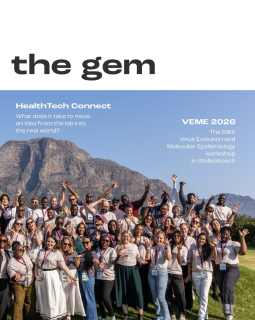
The past two months have been exceptionally busy and rewarding, marking one of our most dynamic periods yet. This special 44-page edition of the gem covers the highlights of September and October 2025, months filled with inspiring collaborations, events, and significant achievements.
The Africa in the World Festival 2025 gathered African leaders, scientists, and innovators in Stellenbosch to reimagine the continent’s future amid global funding shifts. Through powerful dialogues on research resilience and inclusive leadership, the event called for African-led collaboration to drive sustainable change.

CERI 2025 Summer Scientific Series Seminar II focuses The reality of manufacturing diagnostics in Africa and the reality of supply chains/market access in Africa: Case studies of successful and unsuccessful approaches to market entry.

CERI 2025 Summer Scientific Series focuses on bringing the top scientists, innovators and policy makers to present on how scientific advance in Africa can and should translate to innovation and entrepreneurship.

Yesterday, September 18, 2025, the Centre for Epidemic Response and Innovation (CERI), the LaunchLab, Stellenbosch Network and Innovus at Stellenbosch University welcomed a vibrant gathering of innovators at the inaugural Cape HealthTech Connect event at BMRI, Tygerberg campus.
We are proud to announce the launch of the African STARS Fellowship programme, a milestone for Africa. Our first call attracted over 3 000 applicants for just 40 fellowships, which was an extraordinary response that highlights Africa’s scientific talent. A 12-member selection committee from CERI, KRISP, and Institut Pasteur de Dakar carefully reviewed candidates. The first 20 fellows, now in Stellenbosch, have impressed us with their passion and brilliance.

In just weeks, fellows from across the continent have already engaged in leadership, science communication, and innovation training.
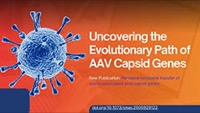
This study reveals that AAV capsid genes have frequently jumped between viral lineages through horizontal gene transfer, reshaping their evolutionary history. These insights not only improve our understanding of viral evolution but also hold practical implications for designing safer and more effective gene therapy vectors.
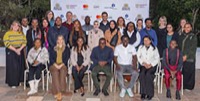
Stellenbosch University has launched the African STARS Fellowship Programme, bringing together young scientists from across Africa for intensive training in genomics, innovation, and leadership. The initiative aims to build the next generation of leaders equipped to tackle the continent’s public health challenges with local solutions and global impact.
This edition is a special one. It shines a spotlight on some of the incredible women at CERI – changemakers who are pushing boundaries in genomics and public health. Their dedication, innovation, and leadership remind us how vital it is to create space for diverse voices in science. We also highlight Prof Lenine Liebenberg’s cutting-edge research in women’s health – from the HPV therapeutic vaccine, to promising developments in live biotherapeutics for genital health.

Dr. Nonsikelelo Precious Hlongwa, a researcher at CERI’s African Microbiome Project, uses genomics to study pathogens, microbiomes, and antimicrobial resistance in under-resourced settings. Passionate about mentorship and African-led solutions, she inspires young women to embrace resilience, seize opportunities, and lead in science.

Dr. Chanelle Mulopo, a postdoctoral fellow at CERI, researches how extreme weather events affect mental health in vulnerable African communities, using participatory and inclusive methods to center local voices. Motivated by her early experiences with health inequities, she advocates for equity, transdisciplinary collaboration, and empowering women in science.

Cari van Schalkwyk, Senior Researcher at SACEMA, applies her expertise in epidemiological modeling to address high-priority infectious diseases, influencing public health policy at national and global levels. Her career reflects a commitment to mentorship, inclusion of women in science, and the translation of complex modeling insights into impactful health interventions.

Emilyn Costa Conceição, a scientist from the Brazilian Amazon, uses genomics and next-generation sequencing to advance TB diagnostics, antimicrobial resistance research, and public health surveillance in Africa and Brazil. Committed to equity and mentorship, she founded the IGNITE program to empower young women in science and ensure innovation reaches vulnerable communities.

Gugulethu Mkhize, Grants Manager at CERI, plays a key role in securing and managing funding that drives impactful scientific research. Passionate about equity and inclusion, she encourages young women to pursue science and seek environments that empower their growth.

Dr. Yuri Munsamy, Science Officer at SACEMA, combines her background in virology with grant development to secure funding for research that shapes public health policy in Africa. She champions collaboration, diversity, and mentorship, encouraging young women to embrace curiosity, persistence, and continuous learning in science.
CERI celebrates Women’s Day 2025 by highlighting the impactful work of female scientists and professionals leading projects in bioinformatics, grants management, epidemiological modeling, transdisciplinary research, and microbiome studies. Their expertise drives advancements in public health, pathogen research, and scientific innovation across Africa and beyond.

The WEMA project explores the overlooked mental health impacts of climate change in Africa through a community-driven, transdisciplinary approach that blends science, storytelling, and policy. By elevating local voices and experiences, it aims to shape compassionate, inclusive climate adaptation strategies.
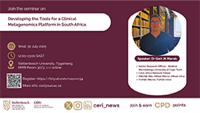
The CERI seminar on 30 July 2025 will showcase Dr Gert JK Marais’s work developing tailored software and wet-lab protocols to make clinical metagenomics affordable and practical in South African diagnostic labs. Attendee, both in person and online, will learn how these innovations are lowering barriers to comprehensive infectious-disease testing in resource-limited settings.
The Centre for Epidemic Response and Innovation (CER) and GIZ have launched the second phase of their genomic surveillance partnership in Cape Town, securing ZAR 12 million to expande pathogen monitoring, capacity building, and data-sharing across Africa. This phase will broaden surveillance to influenza, RSV, H5N1 and emerging COVID-19 variants while strengthening laboratory infrastructure and integrating genomic insigths into public-health policy.
In this issue, you’ll find highlights of a new collaborative program with Germany’s GIZ to enhance genomic surveillance, updates on the use of AI to predict epidemics, and significant scientific publications on HIV drug resistance and HBV evolution. We also mark Youth Month in South Africa.

This month we published a report that helps to build our understanding of HIV resistance to dolutegravir, the antiretroviral drug that is the cornerstone of HIV treatment across the world.

Hepatitis B virus (HBV) infection is a major public health concern, as chronic HBV infection can lead to liver cirrhosis and increase a person’s risk of developing hepatocellular carcinoma (HCC). HBV has been classified into ten genotypes (A to J). Here, we analysed the genotypic diversity and recombination patterns of HBV using 14486 publicly available HBV genome sequences.
When addressing social issues such as inequality, the climate crisis, or systemic injustices, conventional research methods can fall short of delivering real-world impact. This is where participation and transdisciplinary research step in, not only as buzzwords, but as necessary shifts in how we understand and produce knowledge.

Renowned bioinformatician and infectious disease expert Professor Tulio de Oliveira has been awarded the 2025 EDCTP Scientific Leadership Prize for African men, honouring his outstanding contributions to genomic surveillance, pandemic preparedness, and capacity building in Africa.

Artificial Intelligence is reshaping the world, but alongside its promise comes a growing list of ethical challenges. Carlin Foka, a PhD student researcher at CERI, Stellenbosch University, was selected to attend the Mila Summer School on Responsible AI and Human Rights, held from 26 to 30 May in Montreal, Canada.

We’re excited to share that Maambele Khosa (Ambie), Head of Communication at the Centre for Epidemic Response and Innovation (CERI), Stellenbosch University, has been named to the Forbes Africa 30 Under 30 list!

Harriet Ng’ombe, a PhD student at Stellenbosch University and researcher at the Centre for Infectious Disease Research in Zambia (CIDRZ), presented work on genomic research at the 12th EDCTP Forum in Kigali, Rwanda.
MOST POPULAR
BLOG

KRISP has been created by the coordinated effort of the University of KwaZulu-Natal (UKZN), the Technology Innovation Agency (TIA) and the South African Medical Research Countil (SAMRC).


Location: K-RITH Tower Building
Nelson R Mandela School of Medicine, UKZN
719 Umbilo Road, Durban, South Africa.
Director: Prof. Tulio de Oliveira