


NEWS

This intensive, hands-on workshop will use microbiome data as a backdrop to learn R. The workshop will feature morning & afternoon sessions taught by expert faculty and technical assistants. All participants will acquire fundamental computational skills, bioinformatics best practices, exploratory data analysis, and modeling techniques. Deadline for application - 7 Aug 2022.

Please find CERI’s & KRISP’s newsletter June/July issue of 2022. This month’s edition is a celebration of more awards and recognition of the tireless efforts of our teams towards the global pandemic response; but also a reflection on the future, not only of the evolution of COVID-19 sub-variants and their repercussions, but also the emergence or continuation of other viral threats. Another area of interest is the evolution of Monkey Pox to a global health emergency and what that means for the African continent.

Presenter: Dr.Suzanne McCluskey, Assistant Professor, Harvard Medical School, Date: 10 Aug 2022, Locations: KRITH seminar Room (K2), University of KwaZulu-Natal or virtually

The Stellenbosch University has received a grant from the International Bank for Reconstruction and Development (IBRD) for Accelerating Genomics-based Surveillance for COVID-19 Response in South Africa (P177439) and intends to apply part of the proceeds to eligible payments for goods and consulting services to be procured under this project.
Stakeholder Engagement includes the process of engaging stakeholders for a clear purpose to achieve agreed outcomes. It is now also recognized as a fundamental accountability mechanism since it obliges an organization to involve stakeholders in identifying and understanding of the specific program/project and responding to issues and concerns raised by the stakeholders for decisions, actions, and hence improving program/project performance.

The Africa Centres for Disease Control and Prevention (Africa CDC) has since welcomed the decision made by WHO chief Dr Tedros Adhanom Ghebreyesus, but added that the continent had battled the virus before.

The prestigious 'Oscars' of the science, engineering and technology (SET) world took place on 21 July 2022. This, the 24th celebration of South African science, ingenuity, and innovation, is a shining light at a time when the world needs far more good news. The success stories that define this year’s Awards stand out for many reasons, but perhaps the most powerful is how they all showcase how science can play a significant role in driving sustainable development, improving quality of life, and connecting people and communities.

The first case of Covid-19 attributed to a new antibody-avoiding subvariant, BA.2.75, has been detected in Thailand, but experts do not foresee it causing serious outbreaks, according to the Centre for Medical Genomics.

The latest Omicron sub-variant BA.2.75, first detected in India in June, is not dangerous as "hyped" as it is not surging cases or death rates, according to global health experts.
Presenter: Professor Gerhard Walzl, Stellenbosch University Medical School, Date: 13 Jul 2022, Locations: JN De Villiers Auditorium, Tygerberg Campus or virtually

Variants of the original version of SARS-CoV-2 (the virus that causes COVID-19) first made headlines in December 2020. It was a sign that SARS-CoV-2 is more volatile than initially expected.

The BA.5 sub-variant has immuno-evasive properties that cause reinfection even after vaccination and previous illness

COVID-19’s highly transmissible omicron subvariants B.A.4 and B.A.5 drove South Africa’s fifth wave of infections and might offer clues to future outbreaks, experts say. The new variants spread faster than previous ones and caused a spike in hospitalizations in children under 9.
Please find CERI’s & KRISP’s newsletter June/July issue of 2022. What an eventful and action-packed period it has been! In this issue we feature our recent paper on the real-time tracking of the 2022 Monkeypox outbreak, the renaming of Monkeypox to remove the geographic stigma, and our Nature Medicine publication that identified the BA.4 and BA.5 Omicron lineages and how they drove the 5th wave in South Africa.
Presenter: Professor Douglas Pires ,School of Computing and Information Systems at the University of Melbourne, Australia. Date: 22 June2022, Locations: STIAS, Manor House Library, Wallenberg Centre, Stellenbosch or *VIRTUALLY
Laboratory Technologists (x2) at CERI in Stellenbosch University. The purpose of this position is to provide support to CERI's laboratory by conducting research, next generation sequencing and diagnostic tests to meet project deadlines and within allocated turnaround times.

Offered through CAPRISA DSI and NRF Centre of Excellence (CoE) in HIV Prevention The KwaZulu-Natal Research Innovation and Sequencing Platform (KRISP), the state of the art UKZN Research Centre has opportunities for Masters and PhD students with great potential and an ambition to pursue a career in research. Successful applicants will become part of a dynamic research team and they will get hands-on experience in the generation and analysis of genomic, epidemiological and clinical data.

Urgent need for a non-discriminatory and non-stigmatizing nomenclature for monkeypox virus. Proposal would avoid references to West African and Congo strains.

Virtual conference on the lessons learned from Africa on the production of over 100,000 genomes of SARS-CoV-2. Participants from CERI, KRISP, ACEGID, NICD, Africa CDC, Pasteur Insitute Dakar.

BY JOHN NKENGASONG. Scientists in Africa have been monitoring and sequencing pathogens since long before the pandemic. The world benefited from this network when scientists including Sikhulile Moyo, laboratory director for the Botswana-Harvard HIV Reference Laboratory, and Tulio de Oliveira, director of South Africa’s Centre for Epidemic Response and Innovation, identified and reported the emergence of the Omicron variant last November.
Please find CERI’s & KRISP’s newsletter May/June issue of 2022. In this issue, we feature the recent research describing how we worked with the WHO develop an early warning system for emerging SARS-CoV-2 variants and the opinion piece in The Lancet on why African science should have a central place on the world stage and needs to be recognised and supported. We congratulate Professor Tulio de Oliveira and Dr. Sikhulile Moyo on being listed in the Time magazine’s 100 most influential people of 2022.

We are seeking to appoint three post-doctoral fellows with great potential and ambition to become leading scientists. These positions will work with some of the best genomics and bioinformatics scientists in the world. We aim to identify both pathogen and human genomic variation that are associated with the transmission and virulence of pathogens and the development of diseases.

Abbott are offering two long-term fellowships of 12 months and 5 short-term fellowships of 2 weeks. The fellowship will cover travel, accommodation, and a daily stipend.

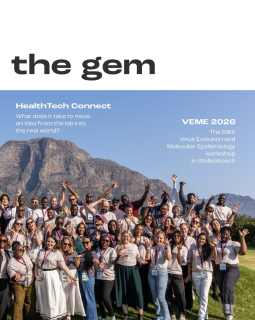
The VEME workshop faculty includes international leading researchers in virus evolution, molecular epidemiology, and bioinformatics. VEME has run for 26 years and it became known as one of the best workshops in the world. This year it will be presented in Panama and applicants from developing countries have priority.
Presenter: Professor Moritz Kraemer, Oxford University, Date: 25 May 2022, Locations: STIAS, Manor House Library, Wallenberg Centre, Stellenbosch or *VIRTUALLY
Presenter: Professor Rob Warren, 11 May 2022, Locations: JN De Villiers Auditorium, Clinical Building, Tygerberg Campus, University of Stellenbosch or *VIRTUALLY

A new modelling study published in the journal Nature is the first of its kind to project how global heating will increase virus swapping between species.
Vaccines and prior infection still prevent severe disease from new SARS-CoV-2 strains. Science, 10 May 2022.

BA.4 and BA.5 can easily break the immunity that was conferred by the earlier Omicron variants such as BA.1 and BA.2, says South African bioinformatics professor Tulio de Oliveira
MOST POPULAR
BLOG

KRISP has been created by the coordinated effort of the University of KwaZulu-Natal (UKZN), the Technology Innovation Agency (TIA) and the South African Medical Research Countil (SAMRC).


Location: K-RITH Tower Building
Nelson R Mandela School of Medicine, UKZN
719 Umbilo Road, Durban, South Africa.
Director: Prof. Tulio de Oliveira