


NEWS

In this special edition of the CERI/KRISP newsletter, we highlight the activities of the Climate Amplified Diseases and Epidemics (CLIMADE) consortium over the past year. On page 2, we feature our participation in the upcoming COP28 meeting in Dubai for the release of the Climate Change and Epidemics 2023 report.

Welcome to another edition of the CERI/KRISP monthly newsletter. In this issue, we are excited to highlight the remarkable efforts on advancing climate and health research taking place across Africa in the realm of pathogen surveillance and research capacity building. Our dedicated team of scientists has been making outstanding contributions to this critical field, garnering well-deserved recognition for their exceptional research endeavors.

The South African Portuguese Chamber of Commerce (SAPCC) & ABSA Business Excellence Gala Awards 2023 held at The Wanderers Club in Illovo, Johannesburg, celebrated outstanding businesses and individuals who've contributed to South Africa's business community.
Stellenbosch University's Research & Innovation Excellence Awards held on October 30, 2023, was a night to remember as the institution celebrated the exceptional contributions of its researchers and innovators ...

The recent Data Science for Biology Workshop Series in Durban, South Africa, showcased the intersection of data science and biology, emphasizing the importance of capacity building and fostering collaboration among participants.
The Centre for Epidemic Response and Innovation (CERI) at Stellenbosch University recently concluded an intensive RNA sequencing training program from October 16th to 23rd.

The 2023 Nobel Symposium in Chemistry Tuberculosis and Antibiotic Resistance – From Basic Drug Discovery to Clinic was hosted at Stellenbosch University.

In the ever-evolving landscape of HIV research and treatment, the 30th International Workshop on HIV Drug Resistance and Treatment Strategies awarded Nália Ismael an award for Best Oral Abstract. Nalia is a PhD student at Stellenbosch University in the Faculty of Medicine and Health Science ...
Grantees of the European and Developing Countries Clinical Trials Partnership (EDCTP3) and the Bill and Melinda Gates Foundation (BMG) Partnership on Genomic Epidemiology participated in the first GenEpi periodic meeting, which coincided with the BMGF Grand Challenges Annual Meeting, an event designed to explore how the global health community can expand the frontiers of science and innovation to save and improve lives ...

In effort to address the crucial connection between climate change and public health, the Botswana Harvard Health Partnership(BHP) and the Embassy of the Federal Republic of Germany Gaborone co-hosted the “Climate Change and Pandemic Preparedness” conference...
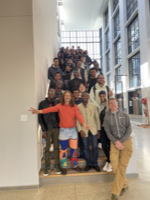
On September 22nd, CERI had the privilege of hosting 40 bright minds from the African Institute for Mathematical Sciences (AIMS) master's program. The day was filled with insightful discussions centered around the theme of #AIforScience and the exciting possibilities of applying artificial intelligence in the biomedical field ...
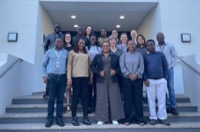
In today's fast-paced era of scientific advancement, being able to secure grants remain essential for driving groundbreaking discoveries and innovative projects. This need is particularly critical for African scientists and researchers, and the Centre for Epidemic Response and Innovation (CERI) has recognized and acted on this imperative.
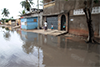
Researchers in sub-Saharan Africa and the UK are working together to tackle the health impacts of climate change, thanks to £2.7 million in new research funding from the Foundation.
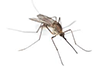
Dr Houriiyah Tegally and Dr Moritz Kraemer from Stellenbosch University and the University of Oxford are looking at human migrations as a result of climate change and their impact on arboviral disease transmission in Sub-Saharan Africa.

Implementation of a new public health strategy for pathogens identification and characterization in the context of climate change: IRESSEF a case study in the surveillance of dengue fever, arboviruses and infectious diseases in Senegal

Time: 12h00 | Wednesday, 27 September 2023, Venue: Room 3073, BMRI, Tygerberg Campus or Online, Presenters: Prof. Alex Sigal, Africa Health Research Institute (AHRI)

Amidst the serene landscapes of Stellenbosch, The Africa in the World Festival, a prestigious annual event, brought together visionaries, innovators, and thought leaders. The festival, spanning from 12-16 September 2023, served as a hub for influential speakers and attendees, all driven by a shared purpose: to catalyze positive change and sustainable solutions for Africa and its global diaspora.
Stellenbosch University's Centre for Epidemic Response and Innovation (CERI) is proud to welcome a new luminary to its ranks, Prof. Lenine Liebenberg, as Chief Researcher in Mucosal Immunology. This addition marks a significant milestone for CERI and the field of immunology as a whole.
CERI at Stellenbosch University: School for Data Science and Computational Thinking is looking to hire a grants manager to expand its grant management unit.

The Centre for Epidemic Response and Innovation will be hosting a grant writing and administration workshop Stellenbosch University on the 23-24 October 2023.

As climate change creates a world in which extreme weather is the norm — so too are large-scale, deadly health outbreaks. And these crises aren’t contained to regions — extreme weather in one part of the world can be linked to health outbreaks in another.
Next week in New York, world leaders are expected to make commitments at the United Nations General Assembly on health and climate — two big issues that are closely intertwined.

A Stellenbosch University-led international consortium has been awarded a multimillion-rand grant to help manage future epidemics in Africa. The grant is from the European and Developing Countries Clinical Trials Partnership, which funded five international awards. The project is the only one led by Africa.
Stellenbosch University (SU) is leading an international consortium that recently received a grant of five million euros (approx. R101 million) from the European Union's flagship research and innovation programme, Horizon Europe, to better diagnose, monitor and clinically manage current and future epidemics in Africa.

Graeme Dor, a PhD candidate at the Centre for Epidemic Response and Innovation (CERI), is applying geospatial and molecular epidemiological techniques to enhance understanding of endemic and emerging pathogens, particularly in Africa . He aims to create actionable insights into pathogen dynamics in Africa, establishing systems for ongoing monitoring. His future endeavors will continue to be at the forefront of public health.
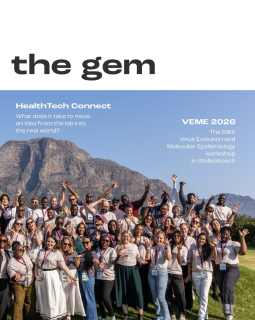
This month newsletter’s cover shows the devastation resulting from extreme weather events in Malawi. This is the topic of our main feature article, published this month in Science, that highlights the link between climate change and infectious diseases. We also feature some of the highlights from the recent VEME workshop that was hosted by CERI at Stellenbosch University and brought together 158 individuals from 39 different countries.
This inaugural lecture held on September 5 highlighted two decades of genomics excellence under Prof. de Oliveira's leadership, propelling Africa into a new era of healthcare and research innovation.

In the intricate web of scientific exploration, one thread stands out for its profound influence on clinical research and public health: bioinformatics. The week-long 27th International Bioinformatics & Virus Evolution & Molecular Epidemiology (VEME) Workshop, hosted by the Centre for Epidemic Response & Innovation (CERI) at Stellenbosch University from August 20th to 25th, recently concluded, leaving a trail of insights and inspiration. This workshop showcased the symbiosis between experts and enthusiasts, forging a path into the realm of molecular data analysis and its practical implications.

New RNA sequences show the path that the virus travelled from the Amazon to the densely populated south. Nature highlights our recent paper at Science Advances.
MOST POPULAR
BLOG

KRISP has been created by the coordinated effort of the University of KwaZulu-Natal (UKZN), the Technology Innovation Agency (TIA) and the South African Medical Research Countil (SAMRC).


Location: K-RITH Tower Building
Nelson R Mandela School of Medicine, UKZN
719 Umbilo Road, Durban, South Africa.
Director: Prof. Tulio de Oliveira