
Tracking Resistance in the Vaginal Microbiome
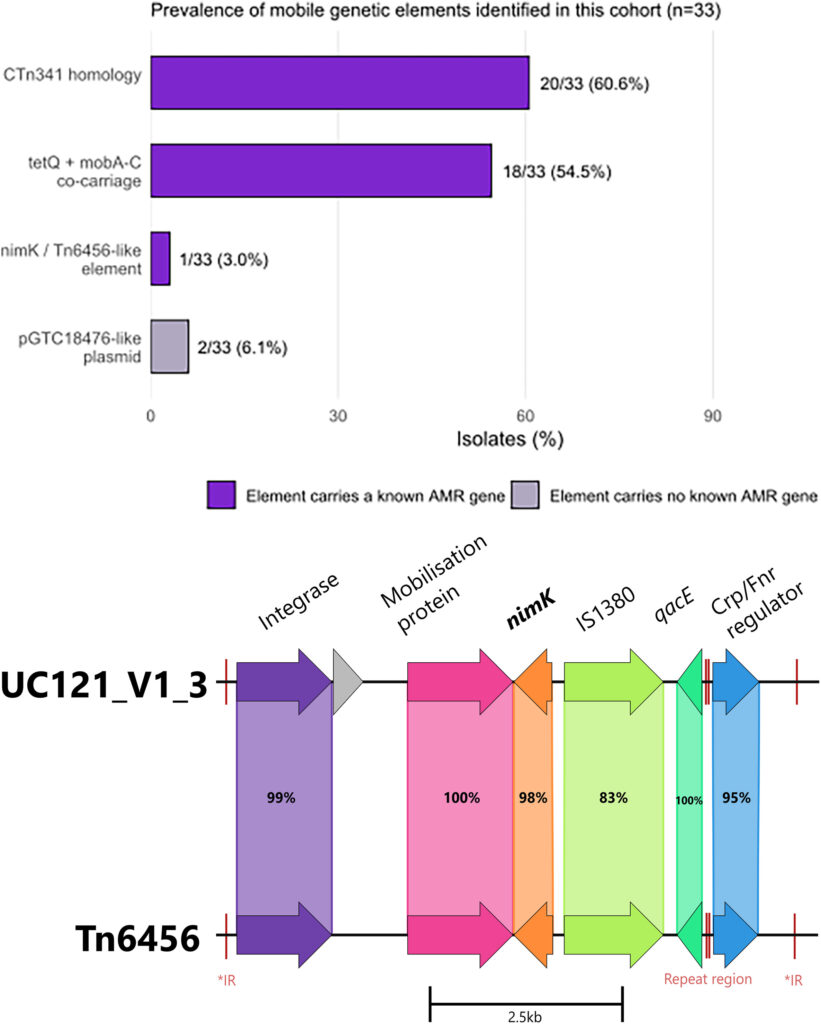
Figure 3 (above): Mobile genetic elements (MGEs) identified in Prevotella bivia isolates. (A) Prevalence of MGEs identified in this cohort (n=33), coloured by whether the element carries a known AMR gene. CTn341 homology and the pGTC18476-like plasmid are detailed further in Supplementary Figs. 1 and 2, respectively. (B) Genomic organization of the Tn6456-like transposon carrying nimK in UC121_V1_3, aligned against the previously described Tn6456 reference. Percentage identity to the reference is shown within each gene arrow. IR: inverted repeat.
A new study led by Kirsten Welp has provided one of the most detailed looks yet at antimicrobial resistance and genomic diversity in Prevotella bivia isolated from South African women. The bacterium is an important component of the vaginal microbiome associated with bacterial vaginosis (BV), a common condition linked to adverse reproductive health outcomes.
The researchers combined antimicrobial susceptibility testing with whole-genome sequencing to characterise 35 P. bivia isolates from 30 vaginal samples. Encouragingly, resistance to the antibiotics commonly used to treat BV – metronidazole and clindamycin – remained relatively low.
Genomic analysis, however, revealed several antimicrobial resistance genes. The tetQ and cfxA genes were detected most frequently, while a particular cfxA variant was associated with amoxicillin resistance. Importantly, the researchers also identified nimK in a South African vaginal P. bivia isolate for the first time. The gene occurred within a mobile genetic element, raising the possibility that resistance determinants could move between bacteria.
The study also found evidence that individual P. bivia strains can persist over time and that different strains can co-exist within the same individual. South African isolates showed genomic differences from many publicly available isolates originating in the United States, reinforcing the importance of generating locally relevant microbiome data.
The study was led by Welp, with Professor Brian Kullin as senior supervisor, and includes CERI Professor of Medical Virology and Microbiome Research Jo-Ann Passmore among its senior authors. Prof Passmore’s research at CERI focuses on women’s health, mucosal immunology, and the vaginal microbiome, with an emphasis on translating African microbiome research into improved diagnostics and interventions.
Read the full paper here: https://www.sciencedirect.com/science/article/pii/S1075996426000661
News date: 2026-10-06
Links:
KRISP has been created by the coordinated effort of the University of KwaZulu-Natal (UKZN), the Technology Innovation Agency (TIA) and the South African Medical Research Countil (SAMRC).


Location: K-RITH Tower Building
Nelson R Mandela School of Medicine, UKZN
719 Umbilo Road, Durban, South Africa.
Director: Prof. Tulio de Oliveira