
What Turns Ebola Spillover into an Outbreak?

When an Ebola outbreak begins, attention understandably turns to the virus: where it came from, how it is spreading, and how transmission can be stopped. But the virus alone cannot explain why some spillover events are contained while others develop into large outbreaks.
A new publication in The Lancet Microbe argues for a broader approach to recurrent Ebola outbreaks – one that considers not only the pathogen and its evolution, but the ecological changes that create opportunities for spillover and the social and structural conditions that determine what happens next.
“The virus is the proximate cause of the disease, but it doesn’t explain the outbreak,” says Prof Carla Mavian.
“Bundibugyo virus did not create conflict, displace communities, weaken health systems or erode trust, and yet those are the things that determine whether a spillover becomes 1 460 cases.”
The distinction matters because the factors that make spillover possible are not necessarily the same ones that determine whether it escalates.
Deforestation, mining expansion, agricultural encroachment, wildlife exploitation, climate variability, migration, and trade can all change interactions between people, animals, and viruses, increasing opportunities for an initial encounter.
What follows depends on a different, although often overlapping, set of conditions.
“Ecological disruption sets up the encounter,” Prof Mavian explains. “Structural vulnerability decides what happens next.”
Conflict, displacement, food insecurity, population mobility, weak health systems, limited access to care, scarce diagnostic capacity, and mistrust can determine whether a spillover is detected early and contained or goes unnoticed and amplifies.
This perspective also changes how human behaviour is understood. Hunting, butchering, forest entry, caregiving, and funeral practices can all be epidemiologically relevant, but Prof Mavian cautions against considering them separately from the circumstances in which people live.
“For communities living near forests, forest use is livelihood, food, medicine and survival,” she says. “Narratives that focus narrowly on bushmeat become stigmatising when they are detached from the poverty, insecurity, displacement and absence of alternatives that shape those decisions.”
Trust is similarly complex. During the 2018–2020 outbreak in eastern Democratic Republic of the Congo (DRC), Prof Mavian says mistrust reflected factors including political exclusion, violence, previous experiences with state and international actors, and perceptions that Ebola attracted substantial international resources while other health needs remained neglected.
“Trust cannot be manufactured during an emergency,” she says. “It comes from sustained investment in reliable services and accountable institutions.”
For the authors, understanding these different layers of risk has practical implications for Ebola preparedness.
Rapid diagnostics, infection prevention and control, clinical care, therapeutics, vaccination where available, contact tracing, and safe and dignified burial remain fundamental to outbreak response. But the publication argues that preparedness must also begin further upstream.
This means bringing together human, animal, and environmental surveillance with genomic and metagenomic monitoring, while also considering land-use change, mobility, conflict, climate, and other factors that influence both spillover and outbreak amplification.
Prof Jean Nachega, first author of the publication and Director of Stellenbosch University’s Biomedical Research Institute (BMRI), was part of an Africa CDC response mission to the DRC in June 2026.
“The future of Ebola preparedness lies in connecting genomics with ecology, epidemiology and social context,” says Prof Nachega. “Genomic surveillance can help us understand how viruses emerge and spread, but preventing outbreaks also requires understanding where environmental change, human vulnerability and fragile health systems intersect.”
Combining genomic surveillance and phylogenetics with environmental and wildlife monitoring, land-use analysis, mobility data, conflict mapping, and mathematical modelling could help identify where the risk of spillover and the risk of subsequent amplification coincide – rather than treating them as the same problem.
This broader view also expands what counts as outbreak prevention.
“Food security should be viewed as epidemic prevention. Peace and protection should be recognised as health infrastructure,” says Prof Mavian. “Ebola preparedness cannot be the responsibility of ministries of health alone.”
Community engagement, the authors argue, should similarly extend beyond messaging during an emergency. Instead, communities should be involved as partners through trusted local messengers, local employment, transparent data sharing, and care and burial practices developed with the people they are intended to serve.
The same principle applies to the science generated during outbreaks. Prof Mavian says outbreak science should be “ethical, equitable, and locally accountable”, avoiding arrangements in which samples, data, authorship, intellectual property, and institutional recognition flow away from the countries carrying the greatest burden.
Ultimately, the publication argues for complementing the ability to respond rapidly to Ebola with investment in the conditions that can reduce the likelihood of outbreaks escalating in the first place.
“If Ebola is understood as a pathogen-centred emergency, investment stays episodic and reactive,” says Prof Mavian. “If it is understood as an ecological, clinical and social event, investment also has to reach environmental stewardship, food systems, conflict reduction, primary care, laboratories, education and community trust.”
Read the full publication here: https://www.thelancet.com/journals/lanmic/article/PIIS2666-5247(26)00144-8/fulltext
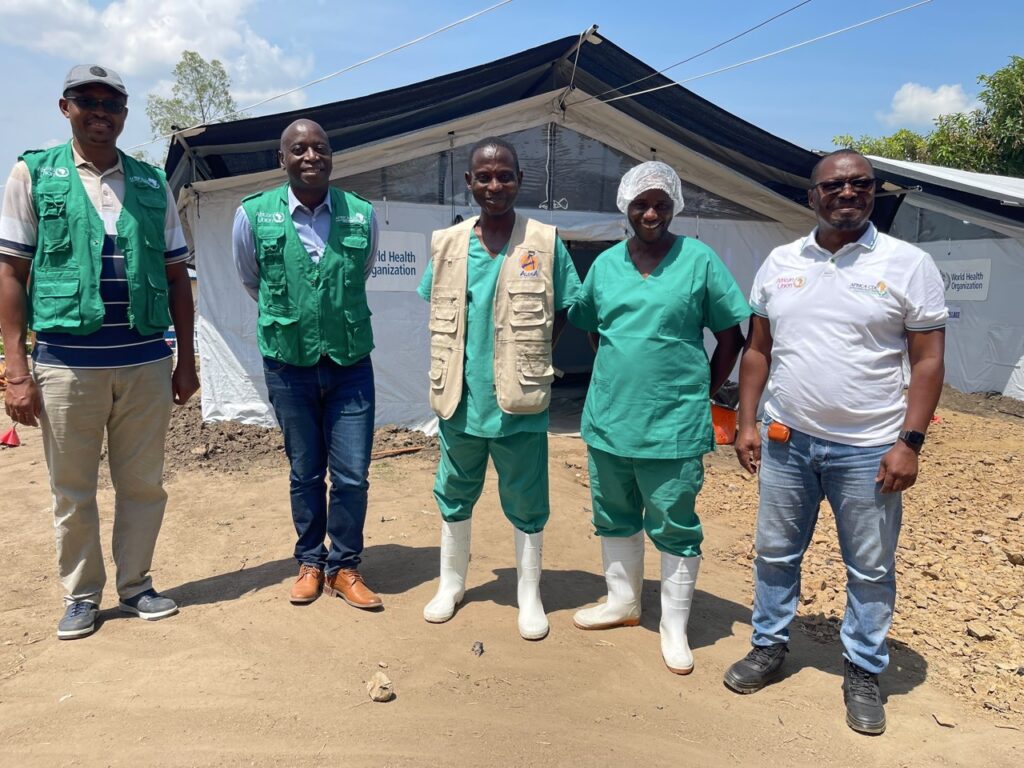
ABOVE: Prof Jean Nachega (second, from left) with frontline Ebola response colleagues at the Rwampara Treatment Center, Bunia, Ituri Province, Democratic Republic of the Congo, during the Africa CDC mission, 12–15 June 2026.
text: Katrine Anker-Nilssen photos: Supplied
News date: 2026-10-06
Links:
KRISP has been created by the coordinated effort of the University of KwaZulu-Natal (UKZN), the Technology Innovation Agency (TIA) and the South African Medical Research Countil (SAMRC).


Location: K-RITH Tower Building
Nelson R Mandela School of Medicine, UKZN
719 Umbilo Road, Durban, South Africa.
Director: Prof. Tulio de Oliveira