
Beyond Artificial Intelligence
text: Katrine Anker-Nilssen
photo: CERI Media
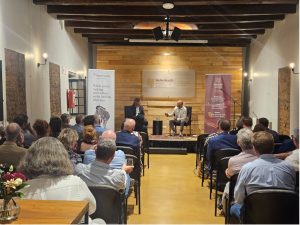
The first Thought Leader Lecture of 2026, held on 8 April at the Stellenbosch University Alumni Clubhouse, brought together Prof de Oliveira and Prof Rajaratnam to explore the role of artificial intelligence (AI) in scientific discovery and public health in South Africa.
AI is often framed as a future breakthrough. But at this lecture, the focus was slightly different â centring on what AI is already doing, and what it means for public health in South Africa right now.
Hosted in partnership with Investec, the session brought together leading voices in genomics and data science, creating a space where academic insight, industry expertise, and real-world challenges came together. As Alfreda Coetzee, Manager: Stewardship of Individual Donors, Development and Alumni Relations, explained, âThe Thought Leader Lecture series aims to create a platform where academic insight, industry expertise, and societal challenges intersect to shape meaningful public dialogue.â
Reflecting on the lecture, Prof de Oliveira described it as very exciting, noting that âwe discussed some applications of AI in science, but in a very focused approach.â One example brought this into sharp focus.
He shared the story of Lucy, a dog diagnosed with cancer and given only months to live. Using AI alongside genomics and bioinformatics, researchers sequenced the tumour, identified key mutations, and incorporated these into a targeted mRNA-based intervention. The outcome was striking â the dog is still alive.
For Prof de Oliveira, the significance extended beyond a single case. âIt is interesting to see how not only AI, but the fields that we work in at the Centre for Epidemic Response and Innovation (CERI), can intersect quite strongly,â he noted. The example reflected a broader shift, where advances were increasingly driven by the integration of disciplines rather than isolated breakthroughs.
At the centre of the discussion was a clear message: AI is not a distant concept, but a present-day tool already extending the reach of overstretched health systems. In South Africa, this is taking shape across diagnostics, predictive analysis, and disease surveillance, where both speed and scale are critical.
Prof Rajaratnam underscored this, noting that âAI has the opportunity to extend the reach of overstretched health systems rather than replacing them.â Rather than substituting healthcare professionals, AI is emerging as a support layer â strengthening decision-making, streamlining processes, and enabling more efficient use of limited resources.
This potential, however, is closely tied to the systems it depends on. A central challenge is data. AI requires large volumes of high-quality, well-structured data to function effectively, yet this remains uneven across the South African health landscape. As Prof Rajaratnam pointed out, âAI needs good data, but good data is exactly whatâs scarce.â While national registries and digital health record initiatives are beginning to build this foundation, progress remains inconsistent, particularly across the publicâprivate divide.
This creates a tension between opportunity and risk. On one hand, AI offers a pathway to broader access â delivering advanced diagnostics and early warning capabilities to communities that may otherwise be underserved. On the other, there is a risk that these systems replicate existing inequalities. âAlgorithms trained on historically unequal data quietly encode that inequality into clinical decisions,â Prof Rajaratnam warned, highlighting how bias can be embedded and scaled if not actively addressed.
These concerns extend beyond technology into governance. With South Africaâs national AI policy still in draft form, the frameworks needed to guide responsible implementation are evolving. Questions around data use, consent, and accountability remain central, particularly in a public health context where the stakes are high.
At the same time, there is a growing shift towards more human-centred approaches globally. Conversations emerging from platforms such as the G20 are beginning to shape how AI is governed and applied, but translating these principles into practice will require coordinated effort across research, policy, and industry.
Looking ahead, the potential impact of AI extends well beyond current applications. âAI will have the biggest impact not only in epidemics, but also in personalised medicine,â said Prof de Oliveira, pointing to the ability to design a specific vaccine or treatment for the cancer an individual has, rather than a generalised approach. This shift could improve efficiency and outcomes, while also supporting the development of therapies with lower toxicities. At the same time, AI will play an increasingly important role in helping to âpredict and prepare for epidemics,â strengthening early warning systems and response strategies.
Beyond the technology itself, the value of the Thought Leader Lecture series lies in its ability to connect these ideas to broader systems. These are not isolated discussions, but part of an ongoing effort to align research, policy, and practice. As Coetzee noted, âThe platform aims to spark meaningful conversations about real-world challenges, and over time inspire practical ideas, collaboration, and informed decision-making that can drive positive change.â
In a country navigating both complex health challenges and rapid technological change, this kind of engagement is essential. It ensures that innovation is not only advanced, but understood, shaped, and applied in ways that are relevant to the realities on the ground.
News date: 2026-05-13
Links:
KRISP has been created by the coordinated effort of the University of KwaZulu-Natal (UKZN), the Technology Innovation Agency (TIA) and the South African Medical Research Countil (SAMRC).


Location: K-RITH Tower Building
Nelson R Mandela School of Medicine, UKZN
719 Umbilo Road, Durban, South Africa.
Director: Prof. Tulio de Oliveira