
South African AMR Research Goes Global
Text: Dr Emilyn Costa Conceição
Photo: Rouxjeane Venter
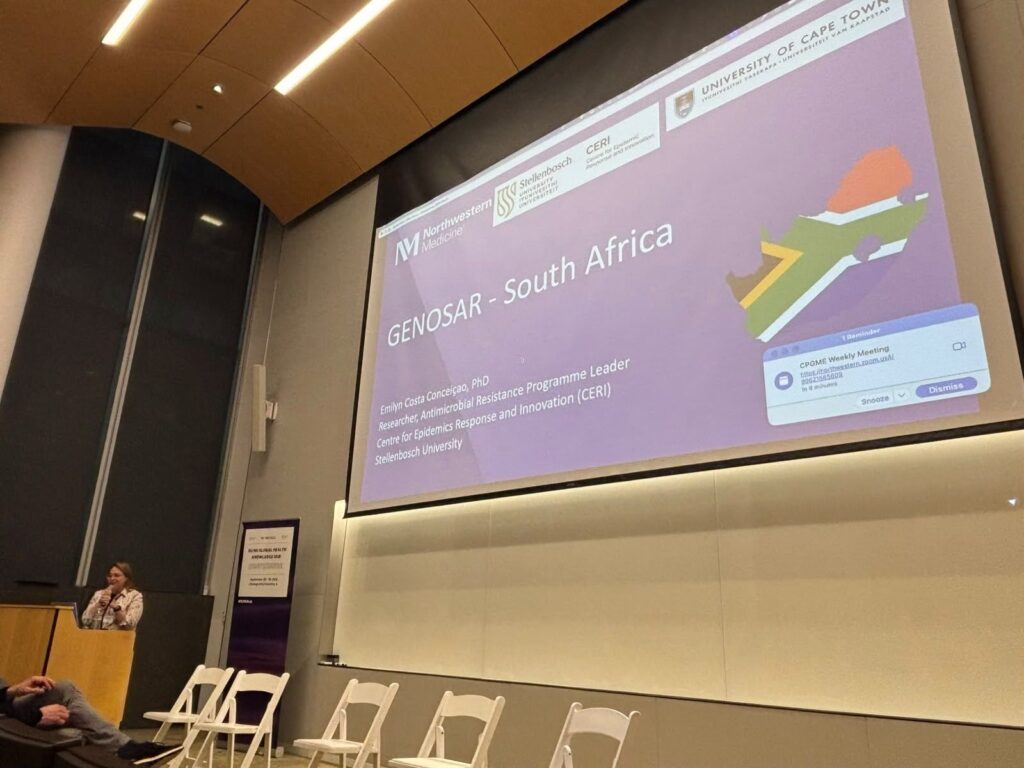
Antimicrobial resistance connects hospitals and communities across borders, and understanding its spread requires collaboration on the same scale. This was the focus of our contribution to the Stellenbosch University–Northwestern University (SU–NU) Hub conference in Chicago, where I had the pleasure of representing CERI alongside Dr Marije Hofstra, medical microbiologist and postdoctoral fellow.
Hosted by Northwestern University’s Robert J. Havey MD Institute for Global Health from 28–30 September 2026, the conference brought Stellenbosch and Northwestern colleagues together on the Chicago and Evanston campuses to share research and explore what we can achieve through our partnership. It was also an opportunity to connect with the people behind projects linking our institutions and discuss future collaboration.
During the Infectious Diseases and Genomics session, I presented alongside Prof Egon Ozer, sharing the South African component of GENOSAR, the Global Genomic Surveillance of Antimicrobial Resistance project. Presenting together allowed us to highlight how our teams are contributing to this international collaboration.
Led by Prof Ozer, Director of Northwestern’s Center for Pathogen Genomics and Microbial Evolution, GENOSAR brings together partners in the United States, Peru, Nigeria, Pakistan, and South Africa. The project is funded by the Lenny Family Global Health Fund, in honour of Robert J. Havey, MD, and in memory of Andrew J. McKenna.
Our research focuses on two bacteria, Escherichia coli and Klebsiella pneumoniae, which can cause infections ranging from urinary tract infections to severe bloodstream infections. When these bacteria become resistant to commonly used antibiotics, treatment becomes more difficult. GENOSAR investigates the genetic changes that contribute to resistance and how resistant bacteria spread.
For us, South Africa’s participation is particularly meaningful. African settings remain under-represented in global genomic datasets, limiting our understanding of the bacteria circulating in our own communities. Contributing local data will help ensure that the international picture better reflects the patients and health systems we serve.
Over five years, GENOSAR plans to generate 6 000 bacterial genomes across four participating collection sites. By combining sequencing results with laboratory and clinical information, the project aims to improve resistance prediction and track the movement of bacterial strains and the genetic material carrying resistance genes. A shared online dashboard will allow researchers to explore these patterns, while training will strengthen surveillance capacity at partner institutions.
In South Africa, this work connects CERI with Prof Andrew Whitelaw and colleagues in Medical Microbiology at Stellenbosch University and the National Health Laboratory Service (NHLS), alongside Dr Ruan Marais and the Division of Medical Microbiology at the University of Cape Town. Isolates from Tygerberg and Groote Schuur hospitals will contribute to the project, linking genomic research with the realities of hospital microbiology.
There was also much to celebrate among the Stellenbosch students. Rouxjeane Venter, from the CLIME Research Group, received the best poster prize, while Caitlin October was part of the winning oral presentation team. Seeing emerging researchers recognised for their work was a highlight of the meeting.
Alongside the scientific programme, conversations with colleagues created opportunities for new ideas, joint planning, and some time to enjoy Chicago. I returned grateful for the Havey Institute’s warm hospitality and excited about the work ahead. We look forward to sharing our progress and welcoming our Northwestern partners to South Africa.
News date: 2026-10-26
Links:
KRISP has been created by the coordinated effort of the University of KwaZulu-Natal (UKZN), the Technology Innovation Agency (TIA) and the South African Medical Research Countil (SAMRC).


Location: K-RITH Tower Building
Nelson R Mandela School of Medicine, UKZN
719 Umbilo Road, Durban, South Africa.
Director: Prof. Tulio de Oliveira