
Virology without Borders: Connecting Science across Africa
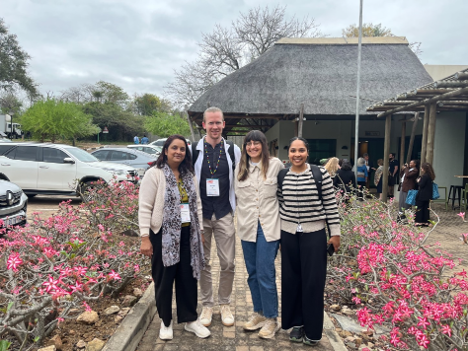
ABOVE, left: Dr Vanessa Ramuth, Graeme d’Or, Prof Carla Mavian, Nikita Sitharam.
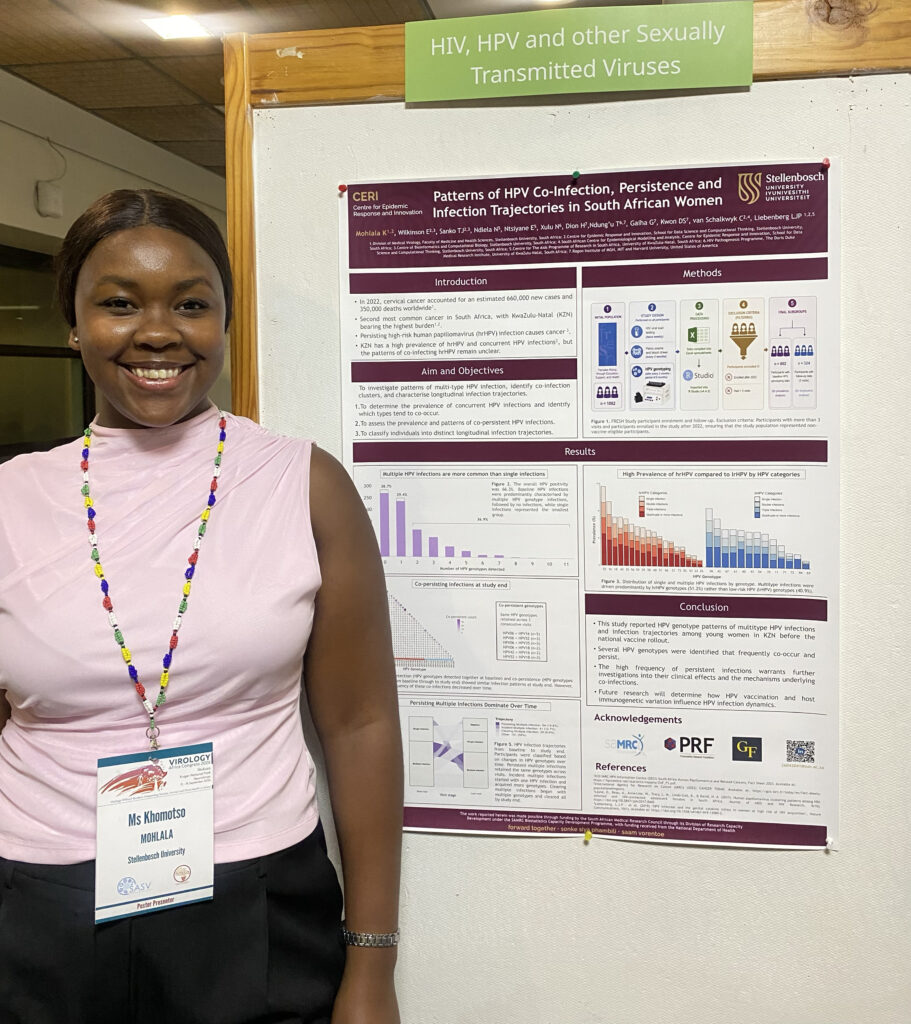
ABOVE, right: Khomotso Mphlala with her poster at Virology Africa.
By Nikita Sitharam
The programme featured nine plenary presentations by local and international speakers, alongside three parallel tracks covering zoonotic, vector-borne, enteric, respiratory, and sexually transmitted viruses, as well as veterinary and plant virology. Together, these discussions highlighted the importance of multidisciplinary approaches to understanding endemic and emerging viruses on the African continent.
CERI was represented by master's student Khomotso Mohlala, fellow PhD student Graeme d'Or and me, alongside Head of the One Health Programme Prof Carla Mavian and medical microbiologist Dr Marije Hofstra.
Khomotso presented research on human papillomavirus (HPV) infections among young South African women, examining the prevalence of different genotypes, co-infections, and patterns of infection persistence and clearance over time. Her findings establish a baseline for evaluating the impact of HPV vaccination on concurrent infections.
Graeme shared his research on the highly divergent BA.3.2 SARS-CoV-2 lineage, first detected in South Africa in November 2024. Using phylogenetic and phylogeographic analyses, his study explored the lineage's evolutionary emergence, potential southern African origin, and subsequent global spread, highlighting its extensive spike protein divergence and potential epidemiological significance.
I presented research on the evolutionary characteristics and transmission patterns of mpox virus (MPXV) across Africa. By examining differences between viral clades and how the virus has spread geographically and over time, the study contributes to a more comprehensive understanding of MPXV evolution and identifies regions with high levels of viral transmission. These findings could help inform genomic surveillance, resource allocation, and public health responses.
For us as students, the conference was a valuable opportunity to present our work to the broader scientific community. At CERI, we are encouraged to consider our research within the wider context of epidemics and infectious disease control. The discussions following our presentations allowed us to exchange perspectives, receive feedback, and expand our professional networks.
One of the highlights was the opportunity to reconnect in person with colleagues we collaborate with closely, including Dr Vanessa Ramuth from the Central Health Laboratory at the Ministry of Health and Wellness in Mauritius.
CERI's collaboration with the Mauritian laboratory began during the SARS-CoV-2 pandemic and proved particularly valuable during the re-emergence of chikungunya in Mauritius, which Dr Ramuth discussed in her conference presentation. CERI supported the laboratory team by providing sequencing reagents, protocols, and phylogenetic expertise, helping to rapidly establish real-time genomic surveillance during the outbreak.
The collaboration also resulted in a joint research paper on the re-emergence of chikungunya in Mauritius, which is available as a preprint. This partnership illustrates how regional scientific networks can support timely responses to emerging viral threats, putting the conference theme of Virology without Borders into practice.
The setting of Kruger National Park also created opportunities to connect beyond the formal conference sessions. Whether during an early morning game drive, walks around the rest camp, or the gala dinner, conversations continued in a setting that brought the interconnectedness of human, animal, and environmental health into focus.
Virology Africa 2026 offered our CERI team an opportunity to share our research, learn from colleagues working across different disciplines, and strengthen existing and new collaborations. We returned with fresh perspectives on our work and a greater appreciation of the scientific partnerships that underpin Africa's response to infectious diseases.
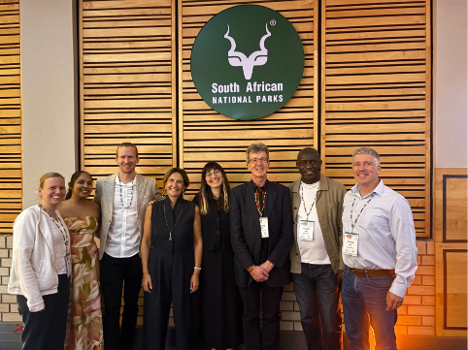
ABOVE: Dr Marije Hofstra, Nikita Sitharam, Graeme d’Or, Dr Alessandra Scagliarini (plenary speaker), Prof Carla Mavian, Prof Wolfgang Preiser (organising committee of the conference), Dr Baptiste Dungu (plenary speaker), and Dr Francois Maree (plenary speaker).
News date: 2026-11-23
Links:
KRISP has been created by the coordinated effort of the University of KwaZulu-Natal (UKZN), the Technology Innovation Agency (TIA) and the South African Medical Research Countil (SAMRC).


Location: K-RITH Tower Building
Nelson R Mandela School of Medicine, UKZN
719 Umbilo Road, Durban, South Africa.
Director: Prof. Tulio de Oliveira