
The Science of Thinking
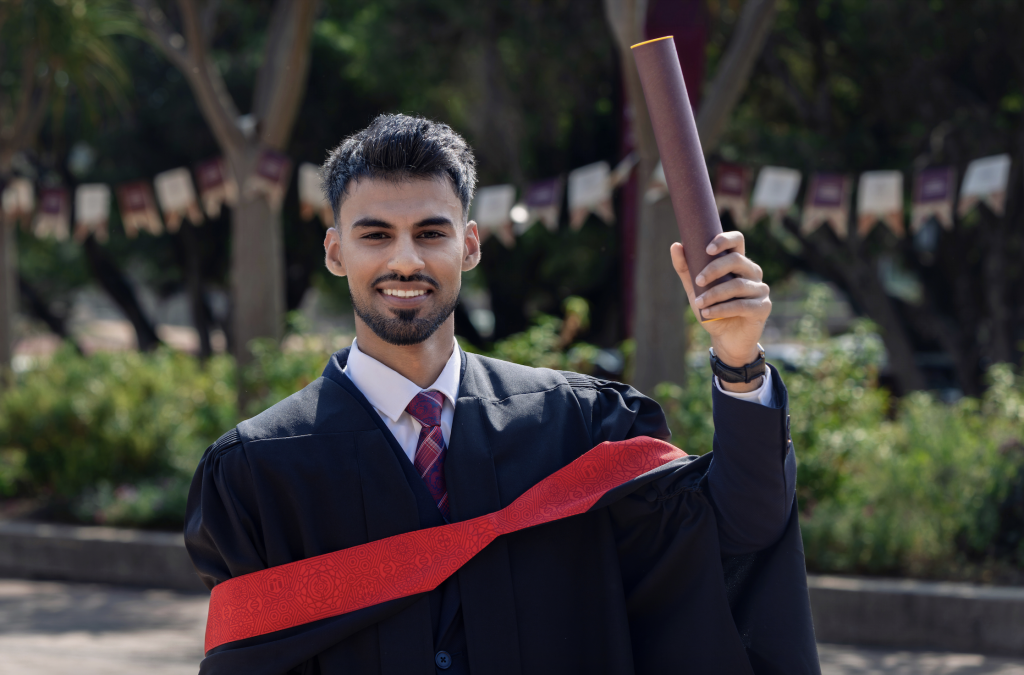
Not every great scientist ends up in a lab. Some take everything science taught them, the rigour, the logic, the ability to look at a problem, work through it systematically, and carry it into industries that never saw them coming.
On 24 March, at the Stellenbosch University Faculty of Science graduation ceremony, Akhil Maharaj walked across the stage to receive his MSc in Bioinformatics and Computational Biology. But the road to that moment started long before, in Durban, where a passion for science, and specifically the statistics behind it, was already taking root.
Akhil completed his undergraduate degree in genetics and microbiology, followed by honours in genetics at the University of KwaZulu-Natal. His first real encounter with high impact science came through an opportunity at KRISP, the KwaZulu-Natal Research Innovation and Sequencing Platform, where he witnessed science operating at its most consequential. That experience set the direction. He went on to pursue his Masterâs at the Centre for Epidemic Response and Innovation (CERI) at Stellenbosch University, where the work deepened and the stakes became even clearer.
His Masterâs research focused on the applications, complexities and opportunities of metagenomics in clinical diagnosis and viral discovery. Metagenomics is the science of sequencing everything in a biological sample at once, not just searching for one known pathogen, but casting the widest possible net.
For public health, the implications are profound. In clinical settings, where a patientâs diagnosis remains unknown, metagenomics gives clinicians a powerful supplementary tool to uncover hidden pathogens, inform targeted interventions, and enhance patient care. In a world still reckoning with the lessons of COVID-19 and the constant threat of emerging infectious diseases, that kind of science matters enormously.
His supervisors, Prof Tulio de Oliveira, Dr Monika Moir, Prof Houriiyah Tegally and Dr Marije Hofstra, played a role that went far beyond the technical. âMy supervisors played a pivotal role in shaping my research journey. Beyond sharing their expertise, they consistently challenged me to think critically and push the boundaries of my work. They were always available for guidance when needed, while also instilling in me a clear understanding of what rigorous, high-impact science should look like.â Akhil reflects.
After years immersed in genomics and research, Akhil made a bold and deliberate move into Corporate and Investment Banking. Far from leaving science behind, he carried its most powerful asset with him: the ability to think critically. âThe skills developed in science translate remarkably well into the financial field. While the underlying theory may differ, the core approach remains the same; identifying problems, formulating and testing hypotheses, and most importantly, translating findings into clear, actionable insights. These shared foundations underpin many of the key qualities required in finance.â
He had long held a keen interest in finance, particularly foreign exchange (FX) trading, commodities and geopolitics. Today he is part of a graduate cohort rotating across multiple business units in Corporate and Investment Banking, gaining the practical experience and exposure that will shape his long-term career.
For young graduates sitting with a science degree and an open horizon, Akhilâs path is a powerful reminder that what you study gives you a way of thinking, and that way of thinking is currency in almost any field.
âStay curious, and take in everything you can. You donât need all the answers right now, what matters is your willingness to explore and grow. Every experience adds a stroke to your journey. The canvas is yours, and you hold the brush. Paint Boldly.â
â Akhil Maharaj
Text: CERI Media
News date: 2026-04-09
Links:
KRISP has been created by the coordinated effort of the University of KwaZulu-Natal (UKZN), the Technology Innovation Agency (TIA) and the South African Medical Research Countil (SAMRC).


Location: K-RITH Tower Building
Nelson R Mandela School of Medicine, UKZN
719 Umbilo Road, Durban, South Africa.
Director: Prof. Tulio de Oliveira