
More Than a Seat at the Table
"What could we build together that none of us could build alone?"
This was the question posed to guests attending The Ecosystem Table, an intimate dinner held at the Dorp Hotel in Cape Town's historic Bo-Kaap neighbourhood on 20 October 2026, alongside the Africa Health Research and Innovation Funders Forum (AHRIFF).
The idea was inspired by a similar gathering in New York organised with Open Startup International, explains Prof Tulio de Oliveira, one of the driving forces behind SWEAT Africa.
The intention was to bring people from across the innovation ecosystem together to explore how they could contribute to the success of entrepreneurship and innovation in Africa.
"We wanted to create a kind of relaxed environment for discussion and engagement, rather than having a meeting in a meeting room," he explains.
Rather than beginning with presentations and pitches, the organisers invited guests to experience Cape Town's culture, music, and storytelling.
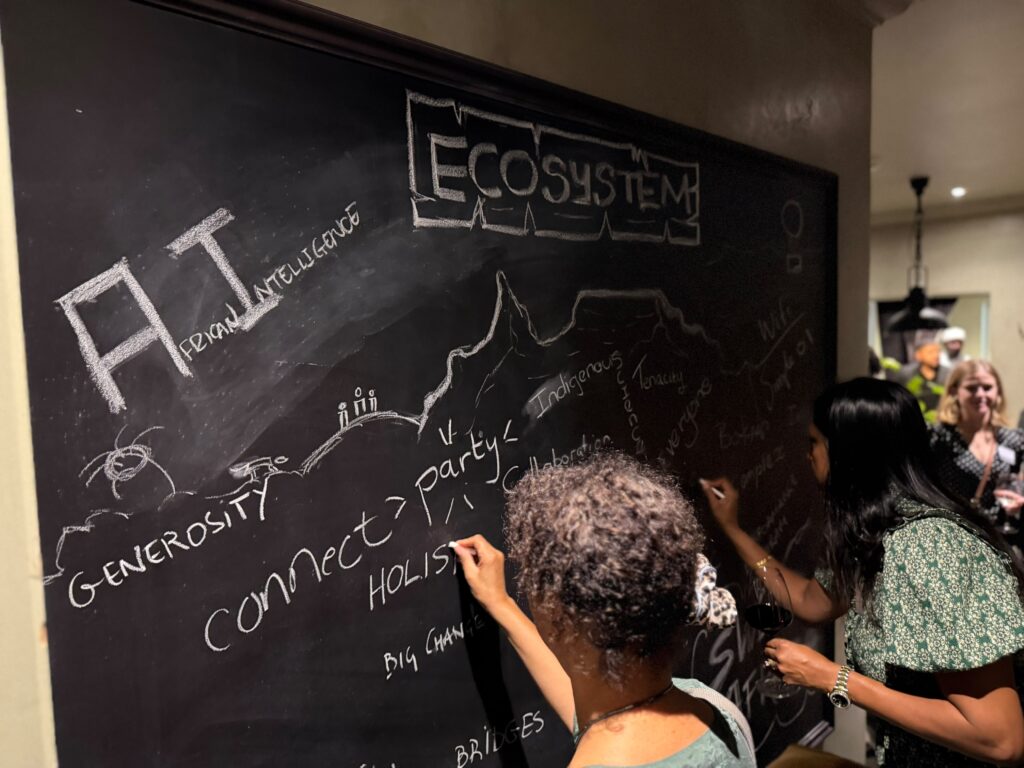
The evening began on the bus, where Yanga Gijani, founder of Yang Steezy Travel, introduced guests to the wider ecosystem they were gathering to discuss. At the hotel, rapper and creative artist Uno July invited participants to share what the word "ecosystem" meant to them, weaving their responses into an improvised spoken-word performance accompanied by Jesse on saxophone.
The inclusion of arts and culture was deliberate, explains Bushra Razack, who helped shape the evening.
"We wanted people to arrive as people first. Music and storytelling relax a room and give everyone a shared experience before anyone starts talking about their work."
The Bo-Kaap setting was equally intentional, offering guests an opportunity to experience a neighbourhood with a rich history and living culture.
A short panel discussion featured Bheki Dube, founder and CEO of Curiocity Africa; Brandon Paschal, Head of Stellenbosch University LaunchLab; and Ross Vermeulen, COO of Fluorobiotech. The discussion explored the idea of the "keystone species" of African science and innovation: what essential element, if lost, could undermine the entire ecosystem?
Their reflections centred on community, networks, and collaboration, reinforcing the importance of trust in connecting people, ideas, and resources.
For Houda Ghozzi of Open Startup, the dinner provided an opportunity to connect with investors and experts who could help address some of the challenges involved in turning scientific discoveries into viable businesses.
"Navigating scientific development, patenting, university negotiations, and market entry requires very different skills, expertise, and networks," she explains.
The evening allowed her to exchange ideas, receive feedback on positioning innovations for the market, and explore potential collaborations. One particularly valuable conversation was with representatives of Wellcome to explore a potential partnership.
The gathering also provided an opportunity to introduce more organisations to SWEAT Africa 2027, which will bring together African startups, investors, researchers, and ecosystem partners in the Cape Winelands on 16 and 17 March.
Andrew Douglas, Producer of SWEAT Africa 2027, attended with a particular interest in connecting with funders and investors working in health and life sciences.
"AHRIFF brought many of the continent's health research and innovation funders to Cape Town in the same week, and the dinner gave us a relaxed setting to meet them, hear what they fund, and talk about where SWEAT fits."
He emphasises that health startups face particular challenges, including regulatory requirements, clinical evidence, and manufacturing, making access to patient capital and knowledgeable partners especially important.
Through the Road to SWEAT competition, startups will have opportunities to pitch their innovations and participate in pre-booked meetings with investors matched to their sector and stage of development.
"Organisations we met that week have asked how their ventures from across the continent can be considered for SWEAT 2027, and how they might run a Track. That is what the evening was for: a dinner conversation that turns into founders in front of funders next March."
For Prof de Oliveira, the ambition extends well beyond the next festival.
"We want to become the most fun, investable, and impactful innovation festival in the whole world, but made in Africa," he says.
His vision is to bring leading technology experts, ambitious young innovators, and investors together in the Cape Winelands to develop technologies that can benefit both Africa and the wider world.
He sees Africa's young population as one of its greatest advantages. With the continent set to account for an increasingly large share of the world's young people, he believes Africa has an important opportunity to shape the future of global innovation.
For Razack, the evening reinforced a principle at the heart of SWEAT Africa's approach.
"Ecosystems aren’t built through transactions. They’re built through relationships, and culture is one of the fastest ways to start them."
News date: 2026-11-06
Links:
KRISP has been created by the coordinated effort of the University of KwaZulu-Natal (UKZN), the Technology Innovation Agency (TIA) and the South African Medical Research Countil (SAMRC).


Location: K-RITH Tower Building
Nelson R Mandela School of Medicine, UKZN
719 Umbilo Road, Durban, South Africa.
Director: Prof. Tulio de Oliveira