
International virology honour: Professor Tulio de Oliveira receives prestigious ESCV Gardner Lectureship Award
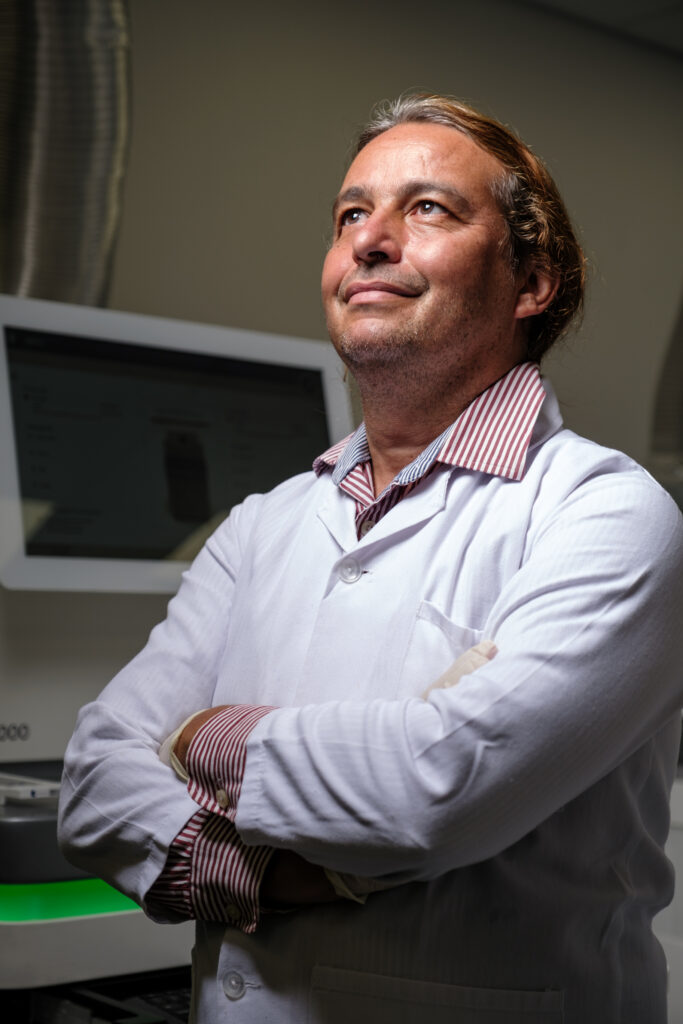
De Oliveira, who was also the founder and Director of the KwaZulu-Natal Research Innovation and Sequencing Platform (KRISP) at the University of KwaZulu-Natal (UKZN), receives the honour at the 28th Annual Conference of the European Society for Clinical Virology (ESCV), taking place in Porto, Portugal, from 16–19 September. For him, receiving the award in Portugal is particularly special as a Portuguese citizen who was appointed a Commander of Portugal’s Order of Merit by President Marcelo Rebelo de Sousa in 2023.
Established in 1995 through a bequest from the late Professor Phillip Gardner, who established the European Group for Rapid Viral Diagnosis, one of the predecessors of ESCV, the Gardner Lectureship recognises scientists with an international reputation in virology. The recipient is invited to deliver the Gardner Lecture at the ESCV Annual Meeting on a subject of importance to clinical virologists, with particular relevance to diagnostic applications and their practical impact.
De Oliveira joins a distinguished international group of Gardner Lecturers awardees whose work has shaped modern virology, including Prof Sarah Gilbert, Prof Charles Chiu, Prof Ralf Bartenschlager, Prof Malik Peiris, Prof Johan Neyts and Prof Florian Krammer.
For de Oliveira, the recognition reflects more than two decades of work at the intersection of viral genomics, bioinformatics, infectious diseases, and public health. He has pioneered the use of genomic surveillance to understand the evolution and transmission of viruses and other pathogens and to translate rapidly generated scientific data into actionable public-health intelligence.
His teams at KRISP and CERI gained worldwide recognition during the Covid-19 pandemic for the rapid identification and characterisation of SARS-CoV-2 variants, including the Beta and Omicron variants. Beyond individual discoveries, de Oliveira has focused on building scientific capacity, infrastructure and networks that have helped position South Africa and Africa at the forefront of genomic surveillance and epidemic preparedness.
“This is a very special recognition for me because clinical virology is ultimately about using science to protect people’s lives,” said de Oliveira, who is also Pro Vice-Chancellor: Industry, Business and Foundation Partnerships at Stellenbosch University.
“During my career, I have tried to combine genomics, bioinformatics and new technologies with public health so that we can identify emerging threats quickly and provide information that governments, clinicians, and communities can act on. Beta and Omicron showed the world what African scientists can achieve when we have the expertise, infrastructure and freedom to act rapidly.”
He emphasised that the award also recognises the scientists who have worked alongside him across South Africa and the African continent.
“I receive this honour as an individual, but science at this scale is never an individual achievement. It belongs to the extraordinary teams at KRISP and CERI and to our collaborators across Africa and around the world. We have worked hard to demonstrate that Africa should not simply be a recipient of scientific knowledge and technology. We can generate discoveries, build technologies, train the next generation and lead scientific responses that benefit the entire world.”
A special South African connection
The Gardner Lectureship also has a notable connection with South African virology. In 2003, the honour was awarded to Prof Robert Swanepoel of South Africa, internationally recognised for his work on viral haemorrhagic fevers and emerging viruses. More than two decades later, de Oliveira’s recognition continues South Africa’s representation among the internationally renowned virologists selected for the Gardner Lectureship.
For de Oliveira, this history is particularly significant given South Africa’s long-standing expertise in emerging infectious diseases and the country’s increasingly prominent role in global genomic surveillance.
“It is a great honour to follow South African scientists such as Professor Swanepoel, whose work on haemorrhagic fever viruses helped establish South Africa’s international reputation in emerging-virus research,” said de Oliveira. “South Africa has extraordinary scientific talent. Our challenge now is to ensure that we continue investing in that talent and create opportunities for the next generation of African scientists to lead globally.”
Prof Sibusiso Moyo, Deputy Vice-Chancellor: Research, Innovation and Internationalisation at SU, congratulated de Oliveira on the international recognition.
“The Gardner Lectureship award is a significant recognition of Professor de Oliveira’s scientific leadership and the international influence of research being conducted from South Africa,” said Moyo.
“His work demonstrates what Stellenbosch University means by research excellence with societal impact. Through CERI and his extensive national and international collaborations, Professor de Oliveira has shown that world-class science conducted in Africa can fundamentally influence how the world understands, detects and responds to emerging infectious diseases.
“We are particularly proud that his work combines scientific excellence with an extraordinary commitment to developing people and infrastructure. His contribution is not only the discoveries his teams make today, but the generation of African scientists he is helping to prepare to confront the epidemics of tomorrow,” Moyo added.
Professor Anil Chuturgoon, Acting Deputy Vice-Chancellor: Research and Innovation at the University of KwaZulu-Natal, also congratulated de Oliveira.
“UKZN warmly congratulates Professor Tulio de Oliveira on receiving the Gardner Lectureship award, an outstanding international recognition of a career that has transformed genomic surveillance and emerging-pathogen research,” said Chuturgoon.
“Through founding and leading KRISP at UKZN, he built a platform that demonstrated the ability of African science to operate at extraordinary speed, technological sophistication and global relevance. The identification and rapid communication of emerging SARS-CoV-2 variants showed how investment in African scientific capacity can protect not only South Africa, but the world.
“We are immensely proud of Professor de Oliveira’s continued association with UKZN and of the scientists, students and collaborators at KRISP who contribute to this work. His recognition by the European Society for Clinical Virology reinforces an important message: some of the world’s most consequential science on emerging infectious diseases is being led from Africa,” Chuturgroon added.
De Oliveira’s current work extends beyond responding to individual outbreaks. Through CERI, KRISP and initiatives including CLIMADE and GenPath Africa, he is working to integrate genomics, epidemiology, climate science, artificial intelligence and advanced data analysis to develop faster and more predictive approaches to epidemic intelligence.
At the same time, his focus remains on developing African scientific leadership, training young researchers and creating the infrastructure required for the continent to move from responding to epidemics to anticipating them.
“The next revolution in epidemic response will come from combining genomics with artificial intelligence, climate information and real-time epidemiology,” de Oliveira said. “Africa has already demonstrated that it can lead in genomic surveillance. Our ambition now is much bigger: to help build a scientific and innovation ecosystem that can predict threats earlier, develop solutions locally and contribute technologies and knowledge to the rest of the world.”
ENDS
About CERI at Stellenbosch University
The Centre for Epidemic Response and Innovation (CERI), based at Stellenbosch University’s School for Data Science and Computational Thinking, works to strengthen Africa’s capacity to detect, understand and respond to epidemic threats through genomics, data science and innovation.
Media Contact
Maambele Khosa
Head: Communications and Marketing
Maambele@sun.ac.za
+27 79 592 9174
News date: 2026-09-15
Links:
KRISP has been created by the coordinated effort of the University of KwaZulu-Natal (UKZN), the Technology Innovation Agency (TIA) and the South African Medical Research Countil (SAMRC).


Location: K-RITH Tower Building
Nelson R Mandela School of Medicine, UKZN
719 Umbilo Road, Durban, South Africa.
Director: Prof. Tulio de Oliveira