
Postdoctoral Research Fellowship: One Health Genomic and Environmental Modelling of Infectious Diseases in Africa
Postdoctoral Research Fellowship: One Health Genomic and Environmental Modelling of Infectious Diseases in Africa
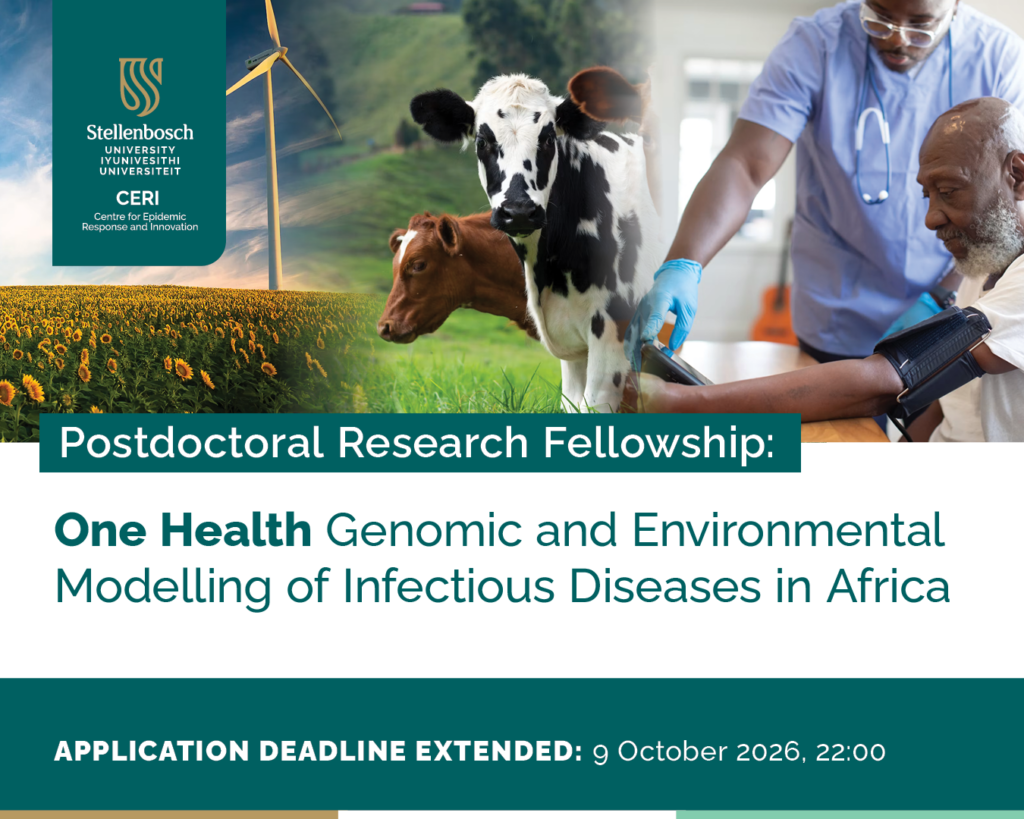
The Centre for Epidemic Response and Innovation (CERI) at Stellenbosch University is inviting applications for a postdoctoral fellowship to integrate pathogen genomics with anthropogenic, environmental, and climate data. The role focuses on modelling the emergence, transmission, persistence, and resurgence of cholera and other climate-sensitive diseases across Africa.
The appointed fellow will join CERI's One Health Program and Data Science Unit, and will be part of the CLIMADE consortium. Working with African and international partners, the fellow will develop spatially explicit and predictive frameworks linking genomic epidemiology to human mobility and displacement, conflict, land-use change, mining and urbanisation, rainfall, flooding, drought, temperature, and access to healthcare. The role centres on translating integrated analyses into actionable evidence for surveillance, preparedness, and resource allocation.
Fellows will apply advanced analytical frameworks to integrate spatio-temporal data for infectious disease research, working within a trans-disciplinary team of leading researchers. The fellowship includes hands-on training in infectious disease genomic epidemiology and mentorship from scientists publishing in journals including Science, Nature, Cell, and The Lancet.
Location: CERI, Stellenbosch University, South Africa, with opportunities for fieldwork and international collaboration, including the University of Oxford and Cornell University
Duration: Up to 3 years
Stipend: Competitive, tax-free fellowship
Key responsibilities
- Integrate genomic, epidemiological, environmental, climatic, demographic, and anthropogenic datasets
- Apply phylogenetic, phylodynamic, phylogeographic, geospatial, statistical, or machine-learning approaches to cholera and other infectious diseases
- Model pathogen movement, transmission corridors, environmental persistence, spillover, and outbreak resurgence across heterogeneous African settings
- Lead manuscripts and contribute to grant development, student mentorship, stakeholder engagement, and multi-country collaborations
Eligibility and requirements
Essential:
- PhD (or equivalent), normally obtained within the past five years, in bioinformatics, computational biology, epidemiology, data science, disease ecology, geography, public health, or a related field
- Strong quantitative skills and proficiency in R and/or Python, with experience analysing large, complex datasets
- Expertise in at least one relevant area: genomic epidemiology, phylogenetics/phylodynamics, spatial modelling, climate-health analysis, ecological modelling, Bayesian statistics, or machine learning
- Evidence of scientific independence, peer-reviewed publications, and effective collaborative communication
Desirable:
- Experience with tools such as BEAST, GIS/remote sensing platforms, or reproducible workflow systems
- Experience working on climate-sensitive diseases, humanitarian settings, environmental surveillance, or collaborative research in Africa
How to apply
- Deadline: 9 October 2026 at 22:00 SAST
- Apply via: Click here to apply
- Submit a cover letter detailing motivation, expertise, and career goals
- Inquiries: Dr Carla Mavian, One Health Program Director, CERI (cmavian@sun.ac.za)
- Start date: 1 January 2026 (flexible)
News date: 2026-08-27
Links:
https://docs.google.com/forms/d/e/1FAIpQLScD1Jii97meFrUaEM8_f-1WVisHfQuqKGgmJwqhjtSniODR0w/viewform
KRISP has been created by the coordinated effort of the University of KwaZulu-Natal (UKZN), the Technology Innovation Agency (TIA) and the South African Medical Research Countil (SAMRC).


Location: K-RITH Tower Building
Nelson R Mandela School of Medicine, UKZN
719 Umbilo Road, Durban, South Africa.
Director: Prof. Tulio de Oliveira