
Call for Applications: Postdoctoral Research Fellowship
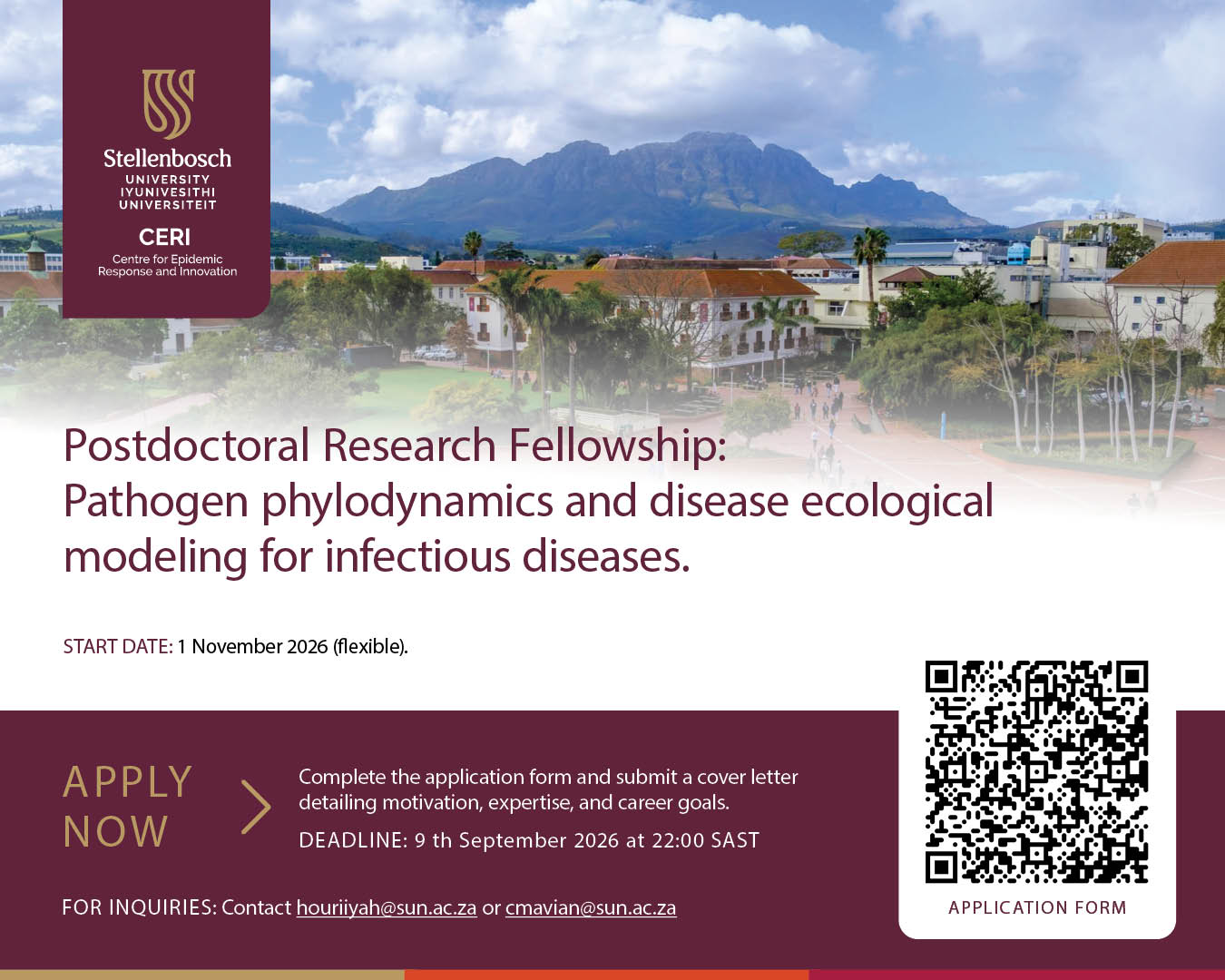
The Centre for Epidemic Response and Innovation (CERI) at Stellenbosch University is inviting applications for one postdoctoral fellowship in pathogen phylodynamics and/or phylogenomics with opportunities for integration of ecological modelling and machine learning to investigate emerging pathogens within shifting landscapes in Africa. Appointed fellows will join the Data Science Unit of CERI and the One Health Program and be part of the CLIMADE consortium, working with large-scale genomic datasets from Africa and beyond to develop advanced analytical methods for infectious disease research.
Fellows will apply advanced analytical frameworks to integrate spatio-temporal data for infectious disease research. They will collaborate with a trans-disciplinary team of leading researchers, receive hands-on training in infectious disease genomic epidemiology, and be mentored by scientists who publish in top-tier journals (e.g., Science, Nature, Cell, Lancet).
Location: CERI, Stellenbosch University, South Africa (with opportunities for fieldwork and international collaborations, e.g., University of Oxford)
Duration: Up to 3 years
Stipend: Competitive, tax-free fellowship
Key Responsibilities
- Reconstruct high dimensional pathogen transmission dynamics using advanced phylodynamics and phylogenomics methods.
- Integrate ecological and behavioural data with viral discovery, metagenomics, and genomic surveillance outputs.
- Model spillover and transmission dynamics using environmental, climatic, demographic, and host–pathogen interface datasets.
- Contribute to building ecological components of early-warning and risk-mapping tools within a One Health framework.
- Publish high-impact research and contribute to proposal development, student mentorship, and inter-institutional project coordination.
Eligibility & Requirements
Essential:
- PhD (or equivalent) in a relevant field, obtained within the last 5 years
- Expertise in at least one of the key areas (phylodynamics, phylogenomics, disease ecology)
- Experience in working with emerging viral pathogens e.g. SARS-CoV-2, arboviruses, mpox, hantaviruses, Ebola
- Proven experience in integrated infectious disease analysis and method development
- Proficiency in Python, R, and geospatial data analysis
- Strong publication record
Desirable:
- Research experience in climate change and infectious diseases
- Experience working in transcapillary teams and leading projects
How to Apply
- Deadline: 9th September 2026 at 22:00 SAST
- Apply via: Please click here to apply for the postdoc or follow the link: https://shorturl.at/LihtL
• Submit a cover letter detailing motivation, expertise, and career goals.
• For inquiries, contact Prof. Houriiyah Tegally, Head of Data Science Unit, CERI (houriiyah@sun.ac.za) and Dr. Carla Mavian, Program Director of One Health, CERI (cmavian@sun.ac.za)
• Start date: 1 October 2026 (flexible).
News date: 2026-08-19
Links:
KRISP has been created by the coordinated effort of the University of KwaZulu-Natal (UKZN), the Technology Innovation Agency (TIA) and the South African Medical Research Countil (SAMRC).


Location: K-RITH Tower Building
Nelson R Mandela School of Medicine, UKZN
719 Umbilo Road, Durban, South Africa.
Director: Prof. Tulio de Oliveira