
Global Surveillance Networks
Newly published paper, Global approaches to infectious disease surveillance and modeling, in Nature, is co-authored by Prof Houriiyah Tegally, Head of the Data Science Unit at the Centre for Epidemic Response and Innovation. It explores how metagenomic surveillance and data integration could transform the way the world detects, tracks, and responds to infectious disease threats.
The paper introduces PathogenGlobal, a framework designed to connect fragmented viral data sources across regions, institutions, and disciplines, creating a more coordinated picture of pathogen emergence and spread. By linking genomic data, environmental sampling, modelling approaches, and public health information, the framework aims to improve early warning systems, strengthen outbreak preparedness, and support faster, more informed public health responses.
The work addresses a major challenge in global health: surveillance data are often scattered across different systems, formats, and organisations, making it difficult to build a complete picture of emerging threats. The authors argue that greater integration, shared infrastructure, and international collaboration will be essential for responding effectively to future epidemics and pandemics.
ABSTRACT
Human mobility, climate change and demographic trends increase the risk of pathogen spillover and expansion. Data that can inform our responses to outbreaks have increased in availability and volume, but access to highly confidential outbreak data and commercially sensitive contextual information remains difficult. Despite ongoing efforts to adopt global health data infrastructures and sharing protocols, there remain regulatory, logistical, human and computational barriers to data sharing. Federated approaches in which data remain under local control while enabling collaborative analysis offer a promising solution. This paper presents PathogenGlobal, a framework for integrating diverse infectious disease data sources to support surveillance, modelling and public health decision-making at a global scale. Through improved interoperability, governance structures and collaborative networks, PathogenGlobal aims to strengthen preparedness for future epidemic and pandemic threats.
For access to the full publication, click here
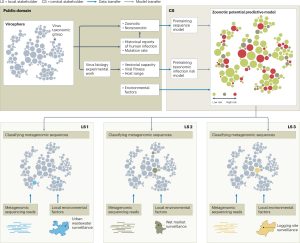
Figure 2 (above):
Current and publicly available knowledge of the virosphere, including genetic data, can be aggregated and combined with experimental work to produce information about key biological features related to cross-species transmission (top left). A central stakeholder can combine this published information to train models linking genetic sequence data (that is, genetic determinants of host specificity) and infection risk data, which are ultimately integrated into a large taxonomic zoonotic potential predictive model (top right). Local stakeholders could run local instances of the model to query locally produced metagenomic sequence data from different surveillance schemes (bottom panels).
News date: 2026-06-03
Links:
KRISP has been created by the coordinated effort of the University of KwaZulu-Natal (UKZN), the Technology Innovation Agency (TIA) and the South African Medical Research Countil (SAMRC).


Location: K-RITH Tower Building
Nelson R Mandela School of Medicine, UKZN
719 Umbilo Road, Durban, South Africa.
Director: Prof. Tulio de Oliveira