
Building Africa's Vaccine Future
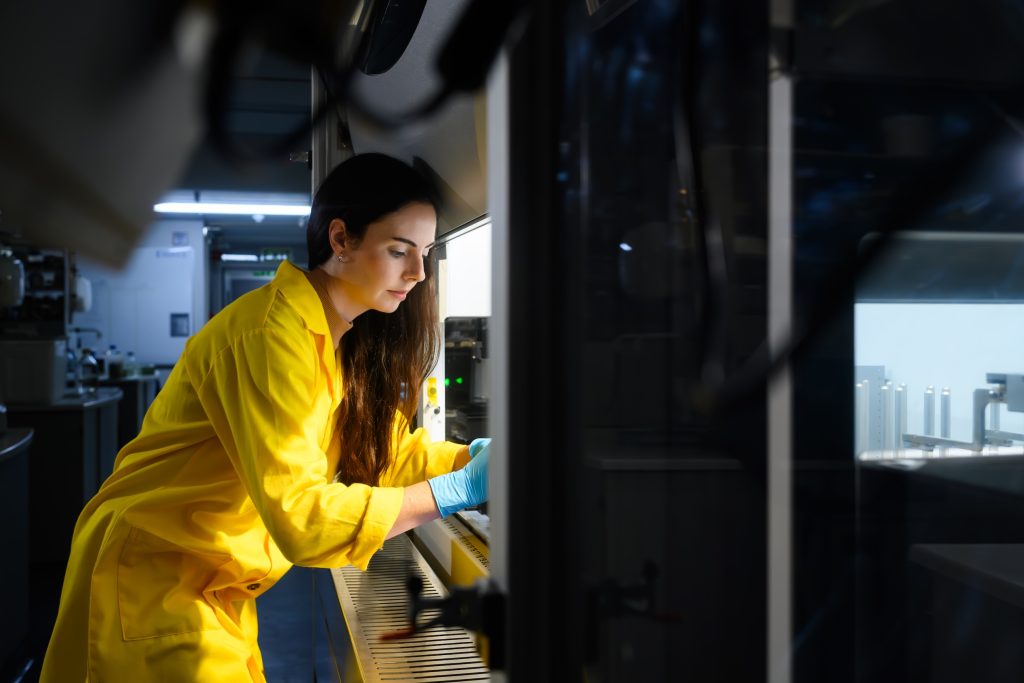
That vision recently received a major boost when Monique was awarded a three-year Research Infrastructure Professionals Programme (RIPP) grant from the National Research Foundation (NRF), focused on advanced automation systems for mRNA vaccine research and production.
The grant centres on training with the Stellenbosch Biofoundrys Tecan Fluent® automation system, a state-of-the-art platform designed for advanced bioengineering workflows. It is currently the only system of its kind in Africa.
The project focuses on two of the most pressing challenges in Africa's mRNA vaccine manufacturing process: improving quality control for locally produced in vitro transcription enzymes, and making DNA template production faster and more reliable, explains Monique. By introducing laboratory automation, we aim to streamline how enzyme quality is assessed, reducing reliance on imported reagents while ensuring that locally produced materials consistently meet international standards.
Monique says that although vaccine development often gets the most attention, the reality is that you cannot produce a vaccine without first having reliable access to the raw materials that go into making it. In Africa, that supply chain has historically been fragile and heavily dependent on imported enzymes, reagents, and other critical inputs that can be delayed, made scarce, or priced out of reach during the very moments we need them most.
Addressing those bottlenecks is not glamorous work, but it is absolutely foundational, she reflects. When we invest in building robust local capacity for producing and quality-checking these materials, we are essentially laying the groundwork for a continent that can respond to health threats on its own terms.
At the centre of this effort is the Stellenbosch Biofoundrys Tecan Fluent® automation technology. What really energises me is the combination of flexibility and precision the system brings, says Monique. Our automation system takes processes that are typically time-consuming, costly, and prone to human error, and transforms them into fast, precise, and reproducible workflows.
The platform allows researchers to automate multiple stages of laboratory work on a single deck, significantly improving speed, reproducibility, and quality assurance while reducing reagent use and operational costs. In the context of vaccine development, where accuracy and speed can genuinely save lives, this is an incredibly powerful thing to have access to on African soil, says Monique.
But beyond the technology itself, Monique sees the project as part of a much broader shift in how science on the continent positions itself globally. If the COVID-19 pandemic taught us anything, it is that depending on the rest of the world to solve our health problems is a vulnerability we can no longer ignore, she says. When we invest in building genuine local expertise in technologies like automation and mRNA systems, we start becoming architects of our own health security.
That shift toward African-led scientific capacity is something deeply connected to her experience as an African STARS Fellow a programme implemented by the Centre for Epidemic Response and Innovation (CERI) at Stellenbosch University and the Center for Africas Resilience to Epidemics (CARE) at the Institut Pasteur de Dakar, in partnership with the Mastercard Foundation.
The fellowship focuses not only on scientific training, but also on leadership development, collaboration, confidence-building, and strengthening the long-term foundations required for sustainable scientific impact across the continent. This aligns closely with the Mastercard Foundations broader impact vision of supporting young people to secure dignified and fulfilling work while strengthening institutions, resilience, and long-term change across Africa.
The African STARS Fellowship built the scientific foundation and sense of purpose that has driven every opportunity since, she says. What the fellowship instilled in me above all else was the understanding that Africa's health challenges deserve African-led solutions, and that as scientists on this continent, we are not just participants in that process, but its driving force.
Working alongside other early-career African researchers also reshaped how she understood leadership and her own place within science. One of the biggest things the fellowship showed me is that being a good scientist and being a good leader are not separate things, she says. You cannot really have one without the other.
Working alongside other young African researchers who were just as passionate and driven as she is, made Monique realise that the continent is not short of capable people it is short of opportunities for those people to be seen and heard. The experience also strengthened her confidence in ways she had not anticipated. On a personal level, it pushed me out of my comfort zone, and I came out of it far more confident in my own voice and my own judgment.
Fulfilling work has always meant science with a reason behind it, for Monique. Not research for its own sake, but because I genuinely believe it can change lives, she explains. So I made a choice to direct my work toward the continent. Not out of obligation, but because it felt like the only honest use of what I'd been given.
Her growing international recognition reflects this. Earlier this year, Monique received an NRF KIC travel grant to attend and present at the fourth International Conference on Vaccine Research and Development in Paris, where global experts discussed next-generation vaccine platforms, pandemic preparedness, AI-driven vaccine research, and emerging technologies shaping the future of global health. I really enjoyed the opportunity to network with experts in this field and to meet different researchers from different countries doing exceptional work, she says.
But her focus remains firmly rooted in African scientific ecosystems and public health realities. There is a tendency in research to measure success purely by publications and discoveries, she reflects, but what I have come to appreciate is that some of the most valuable contributions you can make are the ones that create space for others to thrive building the right systems, developing the right skills, and leaving behind something more capable than what you inherited.
She believes the long-term impact of projects like this reaches far beyond laboratories. For young scientists, it means having something real to work toward locally actual skills, actual infrastructure, and actual opportunities that do not require packing up and leaving the continent to find, she says. For health systems, local production and quality-assured materials mean faster turnaround and lower costs when outbreaks hit, which is the difference between an adequate response and a catastrophic one, she says adding that for the communities who depend on these health systems, it means that the next time a crisis comes, Africa is not caught off guard.
In the near future, I would love to look back and say that we built something that actually works and that people rely on a system that runs smoothly and meets international standards, she says. On a bigger scale, I hope this contributes to a gradual but real shift in how Africa shows up in the global vaccine conversation.
text: Katrine Anker-Nilssen
photos: Peartree Photography
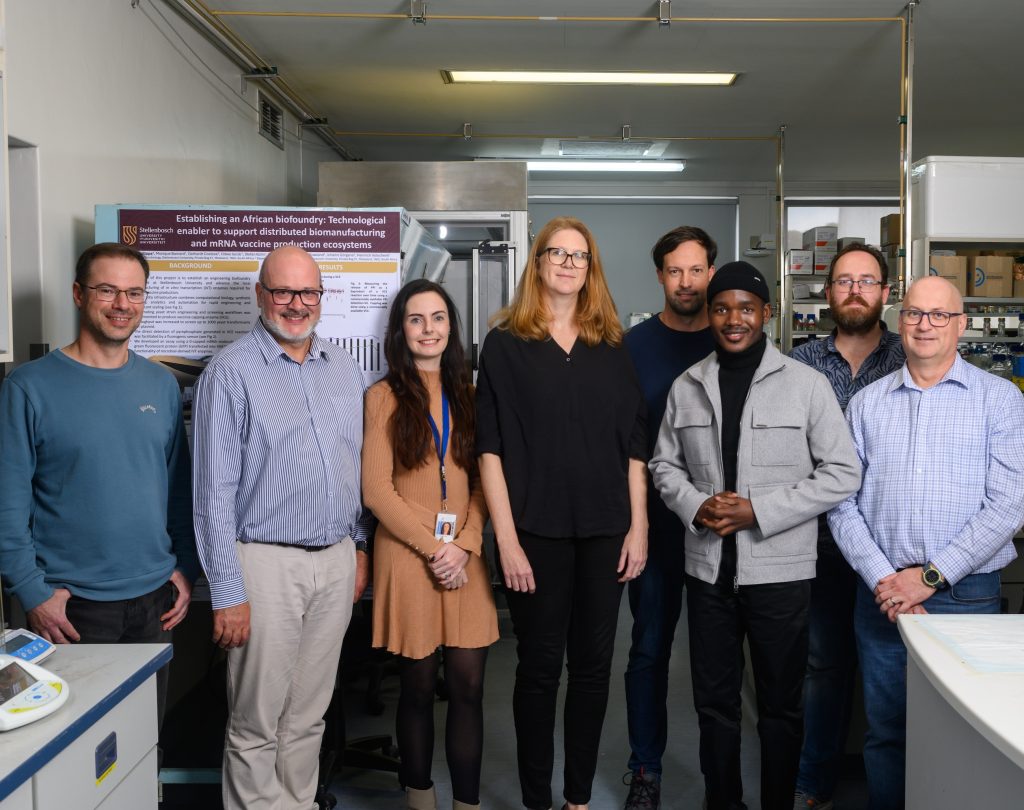
Above: Monique with the Biofoundry team.
News date: 2026-05-20
Links:
KRISP has been created by the coordinated effort of the University of KwaZulu-Natal (UKZN), the Technology Innovation Agency (TIA) and the South African Medical Research Countil (SAMRC).


Location: K-RITH Tower Building
Nelson R Mandela School of Medicine, UKZN
719 Umbilo Road, Durban, South Africa.
Director: Prof. Tulio de Oliveira