
Producing the Tools of African Science at Home
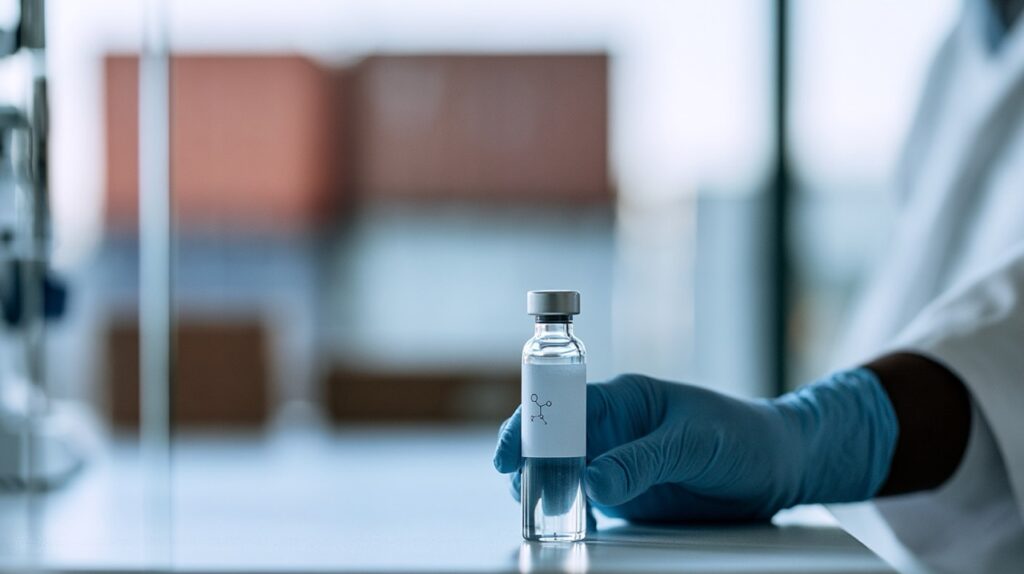
Many of the enzymes and specialist reagents used every day in African laboratories begin their journey thousands of kilometres away. Manufactured overseas, they come with the added costs of international shipping, importation and, in some cases, cold-chain transportation â and researchers can wait weeks for something they need to continue an experiment.
African STARS fellows Grace Bosco Mwakinga, Celestine Kemunto Nyamari, Francisca Serwaa Adomako, Kabugo Joel, and Monique Barnard-Matthee, are exploring how that dependence can begin to change. Working with Fluorobiotech and the University of WisconsinâMadison, the team has been transferring the technology needed to produce TEV protease locally.
âA reagent may be available from a supplier, but it can still take weeks to reach the laboratory because of shipping, customs clearance, and other logistical processes,â says Celestine. âIf a reagent is out of stock, the delay can be even longer. This can interrupt experiments and delay research projects.â
But for Celestine, the frustration of waiting for a delivery points to a much bigger issue. âResearchers can be doing very good science but still be dependent on external suppliers for basic inputs needed to do that work,â she says. âThis makes research more expensive and can make it difficult to plan experiments around when reagents will actually be available.â
TEV protease is one of those essential research tools. The enzyme acts like a highly precise pair of molecular scissors. When researchers produce proteins in the laboratory, they often add a small tag to help produce and purify the protein. TEV protease can then remove that tag without damaging the protein of interest.
âIt is therefore a useful tool in recombinant protein production and is used in many research and biotechnology workflows,â Celestine explains. âHaving access to good-quality TEV protease is important because protein production is part of a wide range of research, including work related to biotechnology, pharmaceuticals, and other applications where recombinant proteins are needed.â
The opportunity to produce it locally emerged during the fellowsâ industry placement at Fluorobiotech. The company already had the infrastructure and capacity to produce recombinant proteins and saw the potential to manufacture TEV protease rather than continue relying on an imported enzyme. It could also use locally produced TEV protease in its own protein purification processes.
The other piece of the puzzle came through an existing relationship between CERI and Professor Brian Fox at the University of WisconsinâMadison. Fox became a mentor to the project, giving the team access to the technology and expertise they needed. The fellows found themselves working between the two environments, learning the process and helping to transfer and implement it at Fluorobiotech.
âFor us, it was important that this was not simply about obtaining the enzyme from Wisconsin,â says Celestine. âThe aim was to understand the process well enough to reproduce it locally, while building capacity that could eventually support both in-house applications and commercial production.â
Then came the milestone they had been working towards: the team successfully expressed and purified TEV protease at Fluorobiotech. They established a laboratory workflow and went through several rounds of optimisation to improve the production and purification process.
For Celestine, seeing the purified enzyme made the achievement real. âWhen we obtained the purified enzyme, that was a very tangible indication that the technology transfer had worked,â she says.
There is still work ahead before the enzyme can become a commercial product. The team needs to further improve yield and purity, demonstrate that the process can be reproduced consistently and integrate TEV protease into Fluorobiotechâs quality management system.
If they get there, researchers and biotechnology companies could eventually have a local or regional source of an enzyme they currently import. Celestine is careful not to put a figure on potential savings before a commercial cost analysis has been completed, but says local production could reduce some of the costs associated with shipping, importation and cold-chain logistics, as well as the time researchers spend waiting for reagents to arrive.
And the potential impact goes beyond TEV protease. Learning how to reproduce a biotechnology process locally builds knowledge and expertise that could potentially be applied to other products, gradually expanding the range of research tools that can be made on the continent.
That learning has been an important part of the project for the fellows themselves. African STARS supported workshops, hands-on laboratory time and virtual mentoring, while connecting the team with mentors and Fluorobiotech. âThe skills and knowledge transferred to us were immense,â says Joel.
For Joel and the team, these ranged from understanding how ISO 13485 is implemented in biotechnology production to advanced protocols for quality protein production, molecular techniques, and activity assays. It gave them experience not only in making an enzyme, but in understanding what it takes to move a biotechnology product towards a quality-controlled manufacturing environment.
Joel sees potential for the same approach to go further. Bringing together scientists, industry partners, and technical expertise to transfer a production process and build the skills to implement it locally could, he believes, be applied to other forms of protein production in Africa.
The experience has also shown the team that being able to make a product is only part of the challenge. Joel points to fragmented regulatory systems across African countries, lengthy and expensive approval processes, the high cost of production when critical raw materials must themselves be imported, and the loss of experienced scientists to better-resourced opportunities elsewhere.
Overcoming those barriers will require changes well beyond the laboratory. Joel highlights the need for greater regulatory harmonisation, investment in manufacturing and quality-control facilities, policies that support African-produced products, pooled procurement, and sustained career pathways for biotechnology scientists.
For the team, the bigger ambition is therefore not simply to produce one enzyme successfully. It is to contribute to an environment in which more of the biotechnology products African scientists, laboratories, and health systems need can be developed and manufactured on the continent.
âSuccess in ten years, to us, is when Africa no longer depends on the Global North for vaccine production, the production and supply of diagnostic kits for Africa-prone pathogens, and there is an integrated regulatory policy across Africa for biotech products,â says Joel.
The TEV project is one early step towards that vision. For Grace, Celestine, Francisca, Joel, and Monique, producing an enzyme locally is also about something bigger: building the knowledge, skills and partnerships that could allow Africa to produce more of the tools its scientists need.

text: Katrine Anker-Nilssen photo: Supplied
News date: 2026-09-03
Links:
KRISP has been created by the coordinated effort of the University of KwaZulu-Natal (UKZN), the Technology Innovation Agency (TIA) and the South African Medical Research Countil (SAMRC).


Location: K-RITH Tower Building
Nelson R Mandela School of Medicine, UKZN
719 Umbilo Road, Durban, South Africa.
Director: Prof. Tulio de Oliveira